
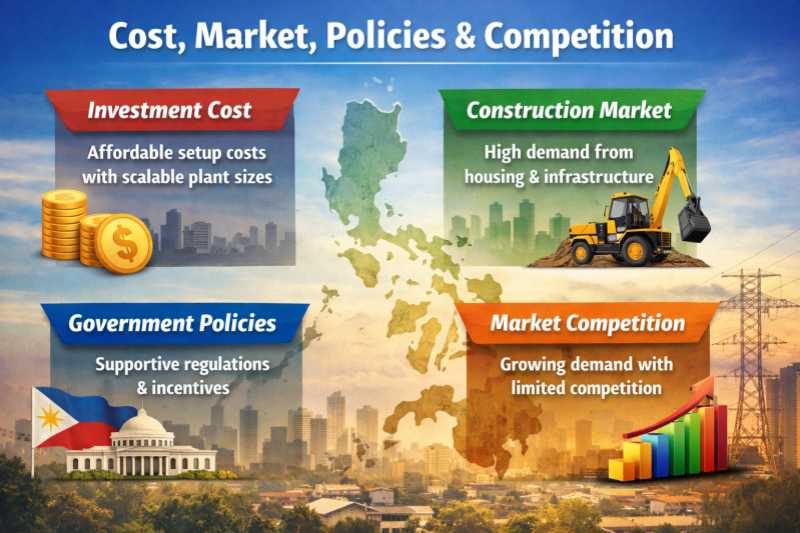
Cost, Market, Policies & Competition
AAC (Autoclaved Aerated Concrete) block manufacturing is one of the most promising manufacturing investments in the Philippines today. Backed by the Build Better More infrastructure program, national housing projects, rising green building standards, and strong government incentives, AAC production delivers stable margins and fast ROI.
We can give you a complete, Philippines‑specific guide for setting up an AAC block plant.
Philippines Construction & AAC Market Overview
The Philippine construction industry is growing at a 6.5%+ CAGR, driven by infrastructure, housing, commercial development, and seismic resilience requirements. Traditional hollow blocks are being replaced by lightweight, thermally efficient, and earthquake‑resistant AAC blocks.
1. Key Demand Drivers
- National housing program (Pambansang Pabahay) creating massive wall material demand
- Build Better More (BBM) infrastructure spending
- Mid‑rise & high‑rise construction boom in Luzon, Cebu, Davao
- Green building codes and energy efficiency regulations
- High logistics costs for imported AAC blocks
2. AAC Market Size (2026–2030)
- 2026: USD 390–430 million
- 2030: USD 610–660 million
AAC blocks are widely used in residential, commercial, industrial, and government projects.
Raw Materials Availability & Cost (Philippines 2026)
AAC production uses widely available materials:
- Fly ash (from Luzon/Visayas power plants)
- Cement, lime, gypsum (local supply)
- Aluminum powder (imported, stable supply)
Typical Raw Material Cost (USD/ton)
- Fly ash: 12–22
- Cement: 98–135
- Lime: 68–98
- Gypsum: 36–58
- Aluminum powder: 2100–2650
Raw material security supports consistent production cost.
AAC Block Market Demand and Price in Philippines
The demand for AAC blocks in the Philippines is driven by residential, commercial, and industrial construction projects:
- Residential Construction: High-rise apartments, housing subdivisions, and affordable housing programs.
- Commercial Projects: Office buildings, shopping centers, and hotels.
- Industrial Construction: Warehouses and factories requiring lightweight, fire-resistant walls.
Current market price for AAC blocks in the Philippines ranges approximately ₱45–₱65 per 600×200×100 mm block, depending on quality, size, and region.
Recommended AAC Plant Capacity for Philippines
Small-Scale Plant

50,000–100,000 m³ per year
Suitable for local or regional demand.
Medium-Scale Plant
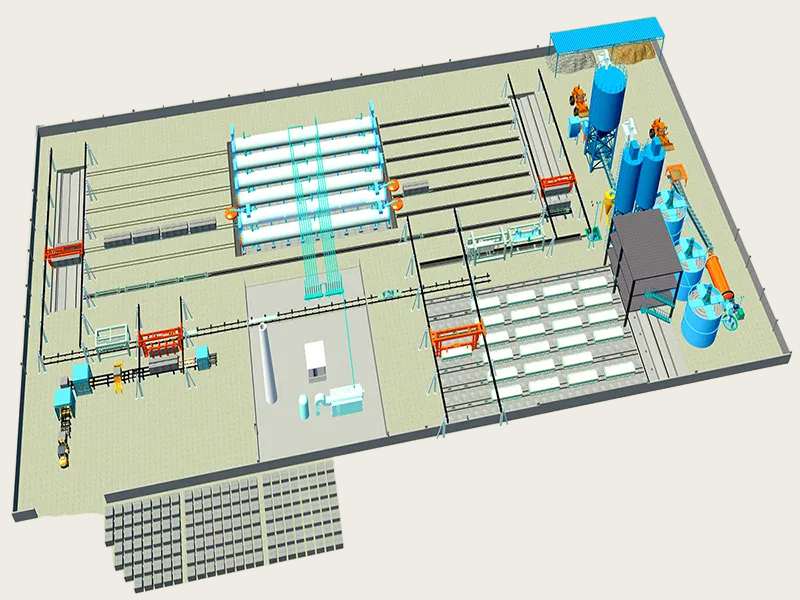
150,000–200,000 m³ per year
Ideal for urban areas with steady construction projects.
Large Industrial Plant

300,000–400,000 m³ per year
Recommended for investors targeting multiple regions or export.
Medium-scale plants are most common, balancing investment cost, production efficiency, and market coverage.
AAC Block Manufacturing Plant in Philippines
A typical AAC block manufacturing plant in the Philippines includes:
- Autoclave Chambers for curing blocks.
- Mixing and Molding Equipment for raw materials.
- Mesin Pemotong for precise block dimensions.
- Conveyors and Storage Facilities to streamline production.
- Peralatan Bantu such as water treatment, air compressors, and forklifts.
Selecting modern and automated machinery ensures consistent quality and high productivity.
AAC Block Plant Investment Cost in Philippines
Investment cost depends on capacity, automation, and location. Approximate ranges for medium-scale plants:
- Land and Civil Construction: $100,000 – $200,000
- Machinery & Equipment: $250,000 – $500,000
- Raw Materials & Initial Inventory: $50,000 – $100,000
- Working Capital: $30,000 – $50,000
- Total Investment: $430,000 – $850,000
Land in urban or semi-urban locations with good transport access is recommended for efficiency.
Philippines Investment Guide Data Table
| Skala Tanaman | Investment (USD) | Kapasitas Produksi | Periode Pengembalian Modal |
|---|---|---|---|
| Kecil | $200,000 – $350,000 | 5,000 – 10,000 m³/year | 4–5 years |
| Sedang | $430,000 – $850,000 | 20,000 – 50,000 m³/year | 3–4 years |
| Besar | $1,000,000+ | 100,000 m³/year+ | 2–3 years |
AAC Block Plant Profit and ROI Analysis
Investing in an AAC block plant in the Philippines can yield stable profits due to high demand, low raw material costs, and efficient production. The following table provides a professional estimate of profitability and ROI for different plant scales. All figures are indicative and may vary depending on location, labor costs, and market prices.
| Skala Tanaman | Annual Production (m³) | Pendapatan Tahunan (USD) | Annual Operating Cost (USD) | Gross Profit (USD) | Net Profit Margin | Estimated ROI Period |
|---|---|---|---|---|---|---|
| Kecil | 5,000 – 10,000 | 250,000 – 500,000 | 150,000 – 200,000 | 100,000 – 300,000 | 40% – 60% | 4–5 years |
| Sedang | 20,000 – 50,000 | 1,000,000 – 2,500,000 | 600,000 – 1,200,000 | 400,000 – 1,300,000 | 35% – 55% | 3–4 years |
| Besar | 100,000+ | 5,000,000+ | 3,000,000+ | 2,000,000+ | 40% – 50% | 2–3 years |
Notes for Professional Consideration:
- Revenue Estimation: Calculated based on an average AAC block selling price of ₱50–₱65 per block (600×200×100 mm), depending on region and demand.
- Operating Costs: Include raw materials, labor, energy, maintenance, and logistics.
- Gross Profit: Revenue minus operating costs, before taxes and financing.
- Net Profit Margin: Reflects profitability efficiency; can be improved through automation and bulk raw material sourcing.
- ROI Period: Time required to recover total initial investment, assuming stable production and market demand.
This structured, table-based analysis helps investors evaluate financial feasibility, choose optimal plant scale, and plan for long-term profitability.
Philippine Government Support Policies for AAC Plants
The Philippines actively promotes modern, eco‑friendly construction materials. AAC block plants qualify for strong incentives under BOI, PEZA, and green manufacturing programs.
Main Incentives
- Income Tax Holiday (ITH): 4–8 years of income tax exemption for registered manufacturing projects.
- Duty‑Free Import of Equipment: Zero tariffs on AAC production machinery, molds, autoclaves, and spare parts.
- VAT Exemption & Zero‑Rating: VAT relief on local purchases and utilities for registered manufacturers.
- Special Corporate Income Tax (SCIT): 5% tax on gross income (in lieu of all national and local taxes) after ITH.
- Green & Prefab Construction Support: AAC is classified as prefabricated/industrialized construction, eligible for:
- Low‑interest green loans via DBP, Landbank, Pag‑IBIG
- Fast‑track permits and environmental compliance
- PEZA Economic Zone Benefits: Simplified visas, reduced utility rates, and full foreign ownership allowed.
These incentives significantly lower startup and operating costs for AAC investors.
AAC Block Market Competition in the Philippines
The Philippine AAC market is supply‑short, import‑dependent, and moderately competitive – ideal for new local producers.
Market Structure
- Local Producers (Small Number)Only a handful of local manufacturers operate full‑scale AAC plants. Most have limited capacity and serve regional markets.
- Major Importers & DistributorsTop importers control a large share via shipments from China, Vietnam, Indonesia, and Malaysia.
- Starken Philippines Inc.
- Blocktec Trading Inc.
- Topbiz Consumer Goods Trading
- Big Stack Imports
- Multinational & Technical SuppliersGlobal brands provide additives, systems, and technical support but limited local production.
Steps to Start an AAC Block Plant in Philippines
- Conduct Market Research: Identify high-demand regions.
- Business Registration & Permits: Secure environmental clearances, local permits, and business licenses.
- Select Site & Construct Plant: Ensure accessibility and adequate space for machinery and storage.
- Procure Machinery: Choose high-quality equipment from reliable manufacturers.
- Source Raw Materials: Establish supply contracts for fly ash, cement, lime, and sand.
- Hire & Train Staff: Recruit skilled operators, engineers, and workers.
- Start Production & Marketing: Launch production and connect with developers, contractors, and distributors.

Our Project Cases in Philippines
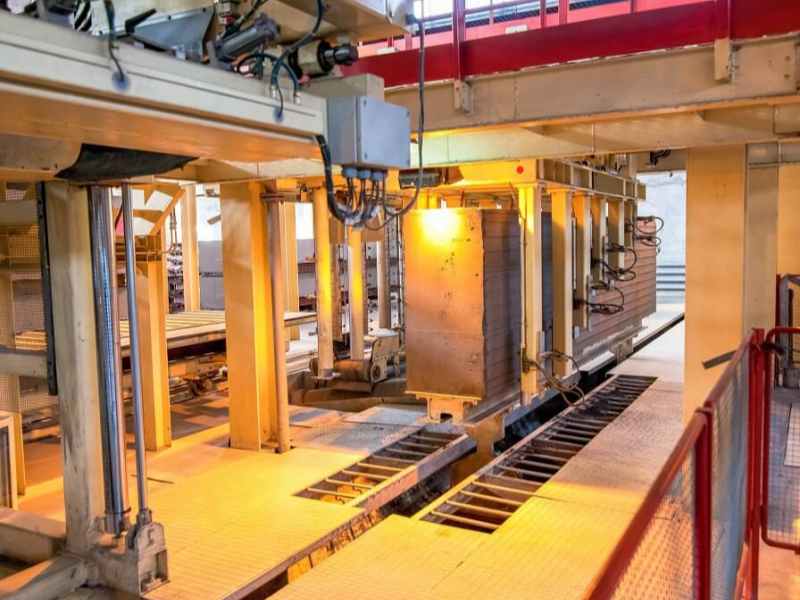
20,000 m³/year AAC Plant for Philippines
Successfully delivered a 20,000 m³/year AAC plant in the Philippines, ensuring efficient production and consistent block quality.
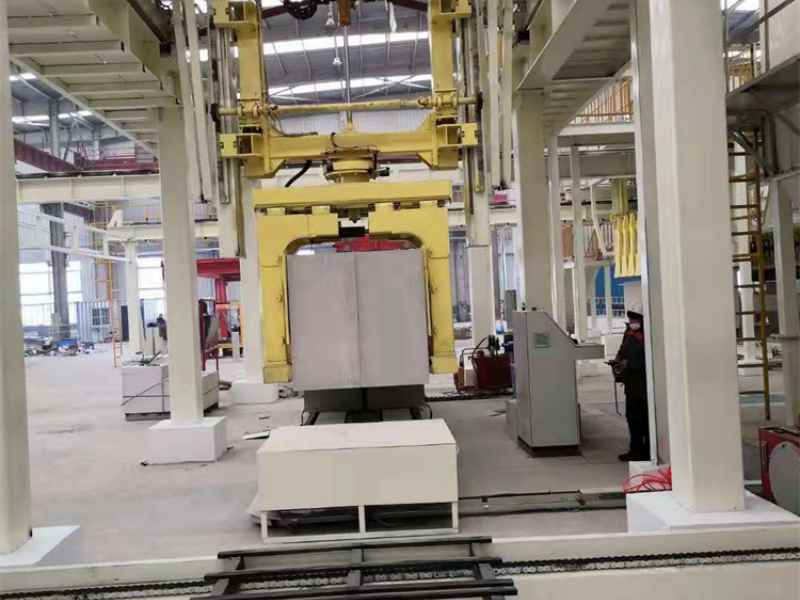
60,000 m³/year AAC Block Plant for Philippines
Built a 60,000 m³/year AAC plant for a large-scale Philippine project, meeting high market demand with reliable performance.
Start Your AAC Block Plant Project in Philippines
With a booming construction industry and rising demand for sustainable building materials, the Philippines is an ideal market for AAC block investment. By combining proper planning, reliable machinery, and efficient operations, entrepreneurs can build a profitable and long-term business in this rapidly growing sector.