
A 100000m3 AAC Block Plant for Egypt is a practical way for investors and building material producers to enter the AAC block market at a meaningful scale. As construction activity continues to increase across Egypt, demand for lightweight and energy-efficient wall materials is growing steadily. Many local companies are therefore looking for production lines that are easy to operate, deliver stable product quality, and support reliable long-term returns without unnecessary operational complexity.
What Is a 100000m3 AAC Block Plant for Egypt?
A 100000 m3 AAC block plant for Egypt is a complete production line engineered to produce autoclaved aerated concrete (AAC) blocks at a medium-to-large industrial scale. This capacity level supports continuous production with reliable output suited to both local construction projects and wholesale distribution.
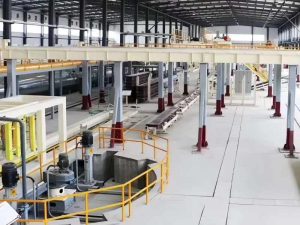
Key components typically include:
- Automated raw material weighing and mixing systems
- High-precision slurry preparation units
- CNC cutting frames for accurate block sizing
- High-pressure autoclaves for curing and strength development
- Material handling and packing systems designed for throughput optimization
This configuration combines production stability with manageable operating complexity—important for first-time plant owners and experienced manufacturers alike.

Why an AAC Block Plant Is a Strong Fit for Egypt?
Egypt’s accelerating urbanization and infrastructure investment have driven robust demand for building materials. AAC blocks are increasingly specified due to their superior properties:
- Excellent thermal insulation suitable for Egypt’s hot climate
- Lightweight structure reduces transportation and structural costs
- Faster construction cycles compared to traditional masonry
- Good fire resistance and dimensional uniformity
With government focus on affordable housing, urban expansion, and sustainability, the 100000m3 AAC Block Plant for Egypt aligns well with local construction trends and long-term industry growth.
Market Demand for AAC Blocks in Egypt
Several factors contribute to growing interest in AAC blocks across Egypt:
- National housing programs: Large-scale social housing initiatives require high volumes of quality masonry units.
- Infrastructure development: Roads, schools, and public facilities increasingly adopt modern materials to meet performance and delivery targets.
- Private sector construction: Residential and commercial developers seek products that offer cost-efficiency and improved thermal performance.
Investors looking at an AAC block plant in Egypt should consider market segmentation, including wholesale supply to distributors, direct delivery to contractors, and branded product offerings for local builders.
Raw Materials Availability in Egypt
One of Egypt’s advantages is the availability of core AAC raw materials:
- Cement: Local cement production capacities are well-established through major producers.
- Lime: Egypt has lime and limestone resources that can support AAC production inputs.
- Silica: Silica sand sources exist, and alternatives such as industrial by-products can be explored.
- Aluminum powder: Readily accessible through local chemical suppliers.
Local raw materials enhance cost control and reduce dependence on imports, which contributes to stable operating margins for a 100000m3 AAC Block Plant for Egypt.
Site Requirements: Land, Utilities & Infrastructure
Proper site selection is critical for successful AAC block production. A typical 100000m3 AAC Block Plant for Egypt should consider:
- Adequate industrial land with room for raw material storage, mixing areas, autoclaves, and finished goods yards
- Reliable electricity supply with backup options to avoid production interruption
- Consistent water access for mixing and curing processes
- Proximity to major transport routes to reduce distribution costs
In Egypt, regions near industrial zones in Greater Cairo, Alexandria, or Upper Egypt (e.g., Asyut / Minya corridor) are often considered due to infrastructure and logistics advantages.
Investment Insights: Cost and Return Expectations
Cost considerations for a 100000m3 AAC Block Plant for Egypt include:
- Capital expenditure (CAPEX) for equipment and factory infrastructure
- Utility setup (power, water, steam generation)
- Installation, commissioning, and operator training
- Initial working capital and product marketing
Return on investment (ROI) will vary depending on local AAC pricing, sales channels, and operational efficiency. Investors often model several scenarios to forecast break-even points and profitability under different demand conditions.
Production, Installation & Training Support
When selecting an AAC plant supplier, practical support and turnkey execution are crucial.
Typical support offerings for a 100000m3 AAC Block Plant for Egypt include:
- Pre-installation consulting and factory layout design
- On-site equipment installation and commissioning supervised by experienced engineers
- Operator training tailored to local workforce capabilities
- Production formula calibration based on Egypt’s raw material profiles
Comprehensive training enables local teams to manage daily production, quality control, and basic equipment maintenance with confidence.
Typical Applications of AAC Blocks in the Egyptian Market
Blocks produced by a 100000m3 AAC Block Plant for Egypt are suitable for:
- Residential housing projects, including villas and apartment complexes
- Commercial and institutional buildings such as offices, hospitals, and schools
- Industrial facilities requiring lightweight non-load-bearing infill
- Interior partition walls with high dimensional precision
AAC blocks’ thermal efficiency and consistent quality make them an attractive choice for builders looking to improve performance and reduce construction timelines.
Expansion Potential: Scalable Production for Future Growth
The modular design of a 100000 m³ AAC block plant for Egypt allows room for future scalability:
- Adding additional autoclaves to increase curing capacity
- Upgrading cutting lines for higher throughput
- Expanding storage, packing, and handling systems
This flexibility enables plant owners to grow capacity progressively as market demand increases.


Почему выбирают нас
We focus on delivering AAC block plants that work reliably under real production conditions. For a 100000m3 AAC Block Plant for Egypt, our approach starts with understanding local raw materials, utility conditions, and labor structures, then configuring the equipment accordingly. We provide complete support from plant design and equipment manufacturing to on-site installation, commissioning, and operator training. Our systems are built for stable output, straightforward maintenance, and long service life, helping investors reduce operational risks and focus on sustainable production and market development.
Interested in Building an AAC Block Plant?
If you are planning to invest in a 100000 m3 Завод по производству блоков AAC, choosing the right production partner is a key first step. We work closely with investors, construction material suppliers, and project developers to evaluate feasibility, define plant capacity, and design production lines that match real market demand and local conditions.
Contact us to discuss your project goals, site conditions, and investment expectations. Our team is ready to provide practical technical guidance and complete implementation support to help you move from planning to stable AAC block production with confidence.




Frequently Asked Questions
Its capacity matches projected local demand while maintaining manageable operating costs and scalable production.
Typically a few months, depending on site readiness and utility access.
Yes. With practical, on-site training, local teams can efficiently run daily production routines and basic maintenance.