
We recently completed the delivery and commissioning of a 100,000 cubic meters per year AAC block plant to Angola, helping local partners expand capacity and supply modern building materials to Angola’s rapidly evolving construction sector.
This turnkey AAC Block Plant to Angola 100000 Cubic Meters is designed to meet Angola’s specific market conditions, providing an efficient, reliable, and cost-effective solution for producing autoclaved aerated concrete blocks and panels for residential housing, commercial buildings, and public infrastructure.
What Is an AAC Block Plant?
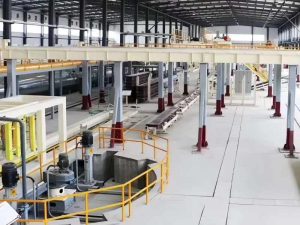
An AAC block plant with a capacity of 100,000 m³ per year is a medium-scale automated factory that produces Autoclaved Aerated Concrete (AAC) blocks and panels. AAC products are lightweight, thermally insulated, and easy to install — characteristics that make them increasingly popular in Angola’s expanding building market.
Key components of the plant include:
- Automated batching and mixing systems
- High-precision cutting machines
- High-pressure autoclaves for curing
- Conveyors and stacking systems
- Control panels and quality monitoring systems
The complete line supports continuous production, ensuring consistent output and quality for customers in Angola.

Project Background: Angola Building Materials Industry
he Angola customer is a leading construction materials distributor based in Luanda, with growing demand driven by urban development and affordable housing initiatives. Previously relying on traditional clay bricks and imported blocks, the company decided to invest in local AAC block production to improve product quality, reduce costs, and serve a broader market.
After reviewing several production options and suppliers, the client chose our Завод по производству газобетонных блоков мощностью 100 000 м³/год for its balance of:
- Investment cost and production efficiency
- Adaptability to local raw materials
- Reliability and support services
The decision reflects the company’s strategy to become a major AAC block supplier across Angola, addressing demand in Luanda, Benguela, Huambo, and other key regions.
Why Angola Needs AAC Block Production
1. Rising Construction Demand
Angola’s construction sector is gaining momentum, driven by:
- Urbanization in Luanda and secondary cities
- Government housing and infrastructure programs
- Increased private commercial developments
These trends create strong demand for modern masonry products that offer performance advantages over conventional materials.
2. Material Performance and Cost Efficiency
AAC blocks are:
- Lighter than traditional concrete blocks
- Faster to install, saving labor time
- Thermally insulating, suited to Angola’s warm climate
- Less material-intensive, reducing overall project cost
These attributes make AAC blocks especially attractive to builders, contractors, and developers focused on efficiency and quality.
3. Sustainable Construction Practices
Sustainability is becoming a priority in Angola’s construction sector. AAC blocks contribute by:
- Reducing energy use in buildings
- Using less raw material per unit of wall
- Optimizing transport and handling efficiencies
As sustainability gains attention, AAC blocks are positioned as a green building material choice.
Local Raw Materials for AAC Block Production
Successful AAC production requires access to raw materials such as:
- Cement — widely available through local suppliers
- Sand — abundant in riverbeds and coastal areas
- Fly ash or alternative pozzolans — sourced locally or regionally
- Aluminum powder — available through chemical distributors
The customer’s plant was configured to leverage locally accessible materials, keeping cost down and ensuring steady supply.
Site Requirements: Land, Power & Infrastructure
For a successful 100,000 m³/year AAC plant in Angola, the site must include:
- Industrial land with space for raw material stock, production halls, and storage
- Stable electricity and backup systems
- Sufficient water for slurry mixing and steam generation
- Road access for logistics and distribution
Sites in and around Luanda Industrial Zones and other logistical hubs were evaluated to optimize transport and utility access.
Installation, Commissioning & Training Support
Our service for the Angola project included:
- On-site installation oversight
- Equipment calibration and workflow setup
- Commissioning with production testing
- Operator training for daily control and maintenance
- Documentation for safe and efficient operations
These services ensured the customer’s team could run and maintain the plant independently as production scaled.
Key Benefits for Angola AAC Block Production
Stable and Reliable Output
With a capacity of 100,000 m³ per year, the plant is capable of meeting large orders from:
- Residential developers
- Commercial construction firms
- Public sector building programs
Improved Production Efficiency
Automated systems and optimized workflows reduce:
- Waste
- Manual errors
- Production delays
This translates to lower operating costs and higher product consistency.
Enhanced Market Competitiveness
By producing AAC blocks locally, the Angola partner can:
- Reduce reliance on imported materials
- Offer competitive pricing
- Deliver faster to customers across urban and regional markets
Application Scope of AAC Blocks in Angola
Blocks produced by this plant are suitable for use in:
- Residential housing and apartment buildings
- Commercial offices and retail facilities
- Institutional buildings — schools and hospitals
- Industrial projects and partition walls
AAC blocks provide advantages in speed of construction, energy efficiency, and long-term durability.
Why Choose Our AAC Block Plant Solution

Interested in Building an AAC Block Plant?
If you are considering establishing an AAC block production facility in your country, we offer customized plant solutions, feasibility assessments, and full project support based on your requirement.
Свяжитесь с нами сейчас for detailed proposals and pricing tailored to your project requirements.




Frequently Asked Questions
This capacity matches growing construction demand while providing manageable operating costs and supply stability.
Installation and commissioning typically take several months, depending on site readiness and utility availability.
Yes. Practical, on-site training equips local operators to run the plant and perform routine maintenance.