
What Is an AAC Production Facility?
An AAC production facility refers to the complete engineered environment where autoclaved aerated concrete blocks are manufactured through an integrated industrial process. It is not simply a collection of machines, but a fully designed production system combining process engineering, material flow, utilities, and automation control.
In industrial terms, there is an important distinction between a “plant” and a “facility”:
- AAC Plant: Often used to describe the equipment line itself (machines + production process)
- AAC Production Facility: Includes the full ecosystem—process layout, civil structure, utilities, energy systems, material logistics, and automation infrastructure
A facility is therefore the higher-level engineering concept, where equipment is only one component of a larger operational system.
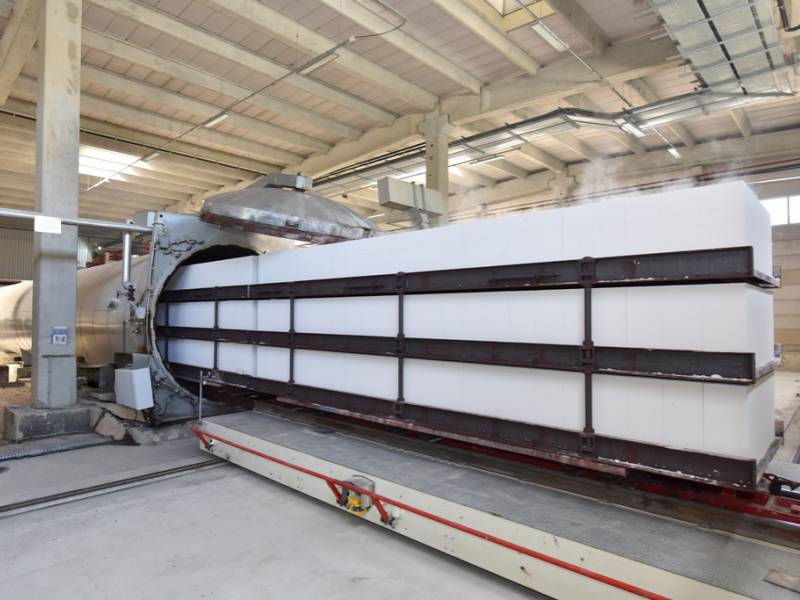
Engineering Structure of AAC Production Facility
An AAC production facility is designed around a linear yet interdependent process layout, where each section must align with the next in both capacity and timing.
A typical facility structure includes:
- Raw material storage and preparation zone
- Batching and mixing section
- Casting and pre-curing area
- Cutting and shaping hall
- Autoclave curing zone
- Finished product handling and storage yard
From an engineering standpoint, the key objective is not compactness, but process continuity and balanced flow capacity.
Layout Logic
The layout is typically designed in a unidirectional flow model:
Raw materials enter from one side → final products exit from the opposite side.
This reduces:
- Cross-contamination of materials
- Equipment interference
- Internal transport time
Flow Principle
Each section is sized based on:
- Cycle time synchronization
- Buffer storage requirements
- Autoclave batch scheduling
Core Systems in AAC Facility
An AAC production facility is built on three core engineering systems that define product quality and operational stability.
1. Slurry Preparation System
This is the foundation of the entire process.
Functions include:
- Grinding sand or fly ash into fine slurry
- Controlling density and particle size
- Ensuring chemical consistency for reaction stability
Any fluctuation at this stage directly affects expansion behavior and final block density.
2. Cutting System
The cutting system determines final product geometry and dimensional accuracy.
It typically includes:
- Horizontal cutting unit
- Vertical cutting unit
- Wire tension and alignment system
This system operates on a narrow timing window where material is semi-hardened but not fully set. Precision here defines:
- Block size tolerance
- Surface quality
- Material waste rate
3. Autoclave System
The autoclave is the core transformation unit of the facility.
It uses high-pressure saturated steam to form stable crystalline structures within the material.
Typical operating conditions:
- Pressure: 1.2–1.3 MPa
- Temperature: 180–200°C
- Cycle duration: 8–12 hours
This stage determines:
- Final compressive strength
- المتانة
- Long-term structural stability
Material Flow Design in Facility
Material flow design in an AAC production facility is not a transportation issue—it is a production efficiency strategy.
A well-designed facility ensures that materials move through the system in a continuous, synchronized loop, minimizing waiting time and avoiding process bottlenecks.
Core Flow Principles
1. Linear Flow Architecture
Materials move in one direction only:
Raw materials → processing → curing → finished goods
2. Buffer Zone Integration
Strategic buffer areas are placed between:
- Mixing and casting
- Cutting and autoclave loading
These buffers stabilize production fluctuations without interrupting the entire system.
3. Cycle Synchronization
Each stage is designed around the autoclave cycle, which is the slowest and most critical process. All upstream and downstream operations must align with this rhythm.
Automation & Control System
The AAC production facility is managed through a centralized PLC-based automation system, designed to synchronize all process stages into a single controlled production loop.
System Architecture
The control system typically includes:
- Central PLC control cabinet
- Distributed I/O monitoring units
- Real-time production dashboard (HMI interface)
- Sensor network across batching, cutting, and autoclave zones
Functional Objectives
The automation system is not limited to machine operation—it ensures:
- Process synchronization across all production stages
- Real-time monitoring of pressure, temperature, and batching accuracy
- Fault detection and early warning systems
- Production data logging for efficiency analysis
Engineering Insight
In industrial AAC operations, automation primarily solves two problems:
- Human timing inconsistency in process transitions
- Lack of visibility in energy and material efficiency
A well-integrated control system typically improves capacity utilization by 8–15% without changing core equipment.
Energy & Steam System Design
The energy system is one of the most critical subsystems in an AAC facility, directly affecting production cost per cubic meter and long-term plant competitiveness.
1. System Components
A standard configuration includes:
- Industrial steam boiler system
- Autoclave steam distribution network
- Condensate recovery system
- Thermal insulation pipeline system
2. Design Principle
The system is designed around one core objective:
Stable steam pressure delivery with minimal energy loss across autoclave cycles.
3. Key Engineering Parameters
- Operating pressure: 1.2–1.3 MPa
- Steam temperature: 180–200°C
- Heat recovery efficiency: optimized via condensate reuse
4. Efficiency Considerations
Energy efficiency is mainly determined by:
- Boiler thermal efficiency
- Autoclave loading rate
- Steam cycle synchronization
- Insulation quality of piping network
Poor steam system design leads to:
- Higher fuel consumption per m³
- Uneven curing quality
- Increased operating cost over time
Facility Scaling Strategy
AAC facilities are typically designed with future expansion capability built into the initial layout.
Expansion Models
1. Modular Expansion (Preferred)
- Additional autoclaves added in parallel
- Batching and cutting systems scaled independently
- Minimal disruption to existing production
2. Capacity Intensification
- Optimization of cycle time
- Improved autoclave utilization
- Automation upgrade without structural expansion
Engineering Planning Principle
A properly designed facility follows:
“Core system oversized slightly + expansion units modularized”
This allows:
- Controlled investment phases
- Reduced shutdown risk during expansion
- Stable ROI scaling
Our Case Study
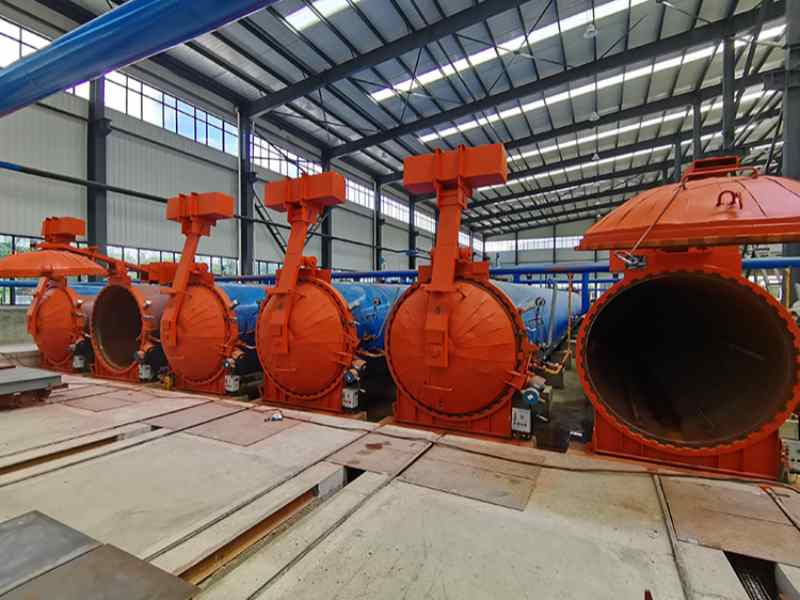
In Indonesia, a 20,000 m³/year AAC production line was delivered for a local investor entering the lightweight construction materials market. The main objective was low-capacity entry with stable production under tropical climate conditions.
Key engineering focus included:
- Compact plant layout for limited industrial land
- Stable slurry and batching system adapted to local sand quality
- Standard autoclave curing system optimized for energy efficiency
- Simplified operation model for easy local training
The facility enabled the client to establish a stable supply chain for regional housing projects with controlled investment risk.

In Singapore, a 20,000 m³/year AAC manufacturing unit was designed for a high-standard construction market requiring precision and consistency.
Project highlights:
- Fully compact plant design for urban industrial constraints
- High-precision batching and cutting system for strict dimensional control
- Fully integrated PLC automation for stable operation
- On-site installation and training for rapid commissioning
After startup, the unit achieved stable production with high consistency in block quality, supporting residential and commercial building supply chains.


