
Recently, we successfully delivered, installed, and commissioned a 100,000 cubic meters per year AAC block making machine to Senegal, marking another milestone in our global expansion across West Africa. This comprehensive plant solution is tailored to Senegal’s construction environment and supports local producers in supplying high-quality masonry products for residential, commercial, and infrastructure projects.
This plant integrates advanced technology and localized configurations to ensure stable performance, efficient output, and cost-effective operation suitable for Senegal’s building materials market.
What Is an AAC Block Plant to Senegal 100,000 m³/Year?
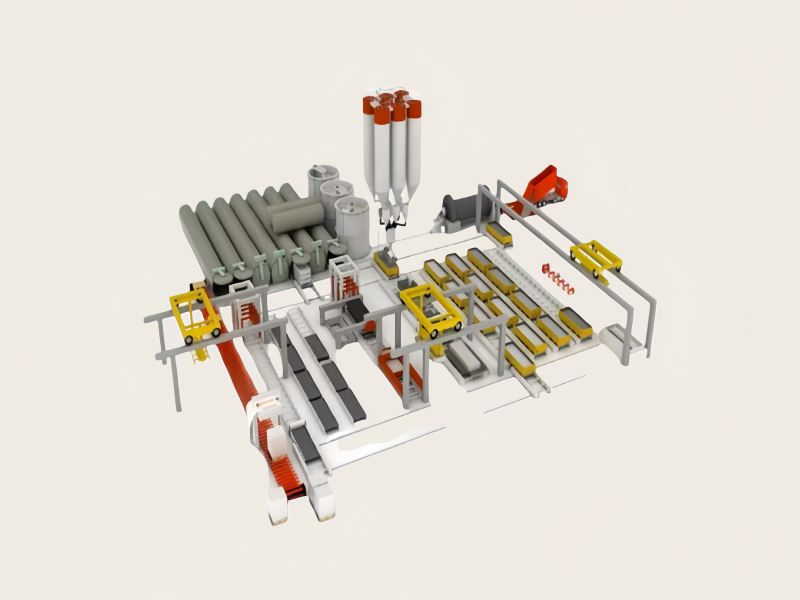
An AAC block plant with 100,000 m³/year capacity is a complete manufacturing line designed for producing Autoclaved Aerated Concrete (AAC) blocks and panels. These building materials are becoming preferred alternatives to traditional clay bricks and concrete blocks due to their combination of lightweight structure, thermal insulation, fire resistance, and dimensional accuracy. The main components of the production line include:
- Automated raw material batching and weighing systems
- High-precision slurry mixing equipment
- CNC cutting machines for blocks and panels
- High-pressure autoclaves for steam curing
- Finished product stacking and packing systems
The system is configured to ensure continuous, reliable production throughout the year based on Senegal’s material availability and industry demand.
Project Background: Why the Senegalese Client Chose AAC Block Production
The Senegalese client is a well-established building materials supplier based in Dakar, with distribution networks covering major cities such as Thiès and Saint-Louis. Facing increased competition and rising labor costs, the company sought to diversify its product range and upgrade its manufacturing capabilities.
After evaluating market trends in West Africa and analyzing local construction demands, the client decided to invest in a 100,000 m³/year AAC block plant to:
- Supply modern, energy-efficient building materials to local contractors
- Reduce dependence on imported blocks
- Improve production efficiency and product quality
- Expand market share in both residential and commercial sectors
The client’s vision was to position the company as a leading regional AAC producer capable of meeting large orders and supporting ongoing and future construction projects across Senegal.
Why Senegal Is a Suitable Market for AAC Block Production
1. Growing Construction Sector
Senegal’s construction market has been expanding steadily due to:
- Urban development initiatives in Dakar and surrounding urban areas
- Government-backed affordable housing projects
- Infrastructure investments including schools, hospitals, and commercial facilities
This growth drives demand for modern masonry products that offer better performance and efficiency than traditional options.
2. Cost and Time Efficiency
AAC blocks are lighter and larger than conventional clay bricks, which leads to:
- Lower transportation costs
- Reduced labor requirements
- Shorter construction timelines
Local builders favor these advantages in projects where speed and cost control are key priorities.
3. Material Performance and Sustainability
AAC blocks provide:
- Good thermal insulation — beneficial in Senegal’s warm climate
- Fire resistance and sound insulation
- Environmentally friendly production with reduced waste
These features help builders and developers achieve higher construction standards with competitive operational costs.
Raw Material Availability in Senegal
Stable raw material supply is crucial for AAC production. In Senegal:
- Cement is widely produced domestically and supplemented with imports
- Pasir sources from coastal and inland deposits are suitable for AAC mix
- Abu terbang can be sourced from industrial by-products with proper logistics
- Bubuk aluminium, gypsum, and lime are readily available through chemical distributors
Local sourcing helps reduce production costs and ensures continuity in the manufacturing process.
Site Requirements: Land, Power & Water
To successfully operate an AAC block plant to Senegal 100,000 m³/year, a suitable site must include:
- Industrial land with space for raw material storage, production halls, and packing areas
- Reliable electricity supply; backup generators recommended for continuous operation
- Adequate water access for slurry mixing and steam generation
- Convenient road access for logistics and distribution
Locations with established industrial infrastructure — including Dakar Industrial Zone dan Thiès Logistics Park — are preferred due to accessibility and utilities.
Installation, Commissioning & Operator Training
Professional installation and training support are essential to ensure stable plant performance:
- On-site supervision for equipment assembly
- Step-by-step commissioning across all production sections
- Operator training focused on actual manufacturing workflows
- Maintenance guidance to reduce downtime
Training ensures that local technicians and operators can independently manage daily production and quality control.
Investment Considerations & Production Outlook
Key investment components for a 100,000 m³/year AAC block plant in Senegal include:
- Equipment procurement and installation
- Site preparation and utility connections
- Workforce training and initial operational expenses
- Distribution and market development planning
Due to increasing adoption of AAC blocks in Senegal’s construction sector, strategic positioning can yield favorable production efficiency, lower unit costs, and long-term supply stability.nage daily production and quality control independently.
Applications of AAC Blocks in Senegal
Blocks produced from this plant are suitable for a wide range of construction projects:
- Residential buildings: apartments, villas, and housing estates
- Commercial structures: offices, retail spaces, hotels
- Institutional facilities: schools, health clinics, government buildings
- Partition walls and infill applications
AAC products support faster construction cycles, reduce structural weight, and help improve building performance.
Scalability & Future Expansion
A plant configured for 100,000 m³/year production can be expanded as demand increases. Typical enhancements include:
- Additional autoclaves for higher steam curing capacity
- Advanced cutting systems for higher throughput
- Expanded storage, packing, and material handling facilities
Modular design allows production scaling without significant disruption to ongoing operations.

Mengapa Memilih Kami

Experienced Provider: Years of delivering AAC block plants to global markets
Turnkey Support: From design and manufacturing to commissioning and training
Localized Solutions: Equipment and configurations adapted to local materials and climate
Reliable After-Sales: Continued technical support and guidance for expansion
Interested in Building an AAC Block Plant?
Whether planning a small, medium, or large-scale AAC factory, we offer complete solutions tailored to your land, budget, and market goals. Contact us now for a free feasibility analysis and customized quotation for your project in your country.




Frequently Asked Questions
This capacity matches growing construction demand while providing manageable operating costs and supply stability.
Installation and commissioning typically take several months, depending on site readiness and utility availability.
Yes. Practical, on-site training equips local operators to run the plant and perform routine maintenance.