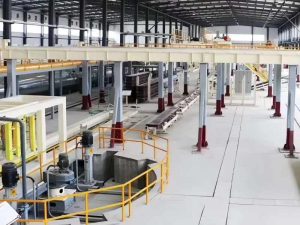
AAC Block Factory for Sale: Turnkey Plant Solutions
An AAC block factory is not a single machine purchase—it is a complete engineered production system designed to convert raw materials into autoclaved aerated concrete products at industrial scale. When we refer to “factory for sale” in the AAC industry, we are typically referring to a fully integrated turnkey production plant, including process design, equipment supply, installation, and commissioning support.
Modern AAC factories are delivered as process-based industrial solutions, not isolated equipment packages.
What Does “Factory for Sale” Mean in AAC Industry?
In practice, “AAC factory for sale” can refer to two very different business models: EPC turnkey plants et second-hand production lines. Understanding the difference is critical before making any investment decision.
EPC Turnkey AAC Factory (Engineering, Procurement, Construction)
This is a complete project delivery model, where the supplier is responsible for:
- Process design and plant layout
- Equipment manufacturing and integration
- Civil engineering guidance
- Installation and commissioning
- Operator training and technical support
The key advantage is system compatibility—all components are designed to work as one integrated production line.
Second-Hand AAC Factory
This refers to used or relocated equipment, typically purchased from decommissioned plants.
Common characteristics:
- Lower initial purchase cost
- Limited process optimization
- Higher integration risk
- Uncertain equipment lifespan and compatibility
In many cases, second-hand lines require significant re-engineering and refurbishment to reach stable production.
Turnkey AAC Factory Solution Overview
A turnkey AAC factory is delivered as a fully engineered production system, not a collection of machines. The goal is to ensure that raw materials, equipment, and process control are fully synchronized from day one of operation.
A standard turnkey scope includes:
- Complete process design (flow, capacity, layout)
- Raw material handling system
- Système de dosage et de mélange
- Cutting system (horizontal & vertical precision cutting)
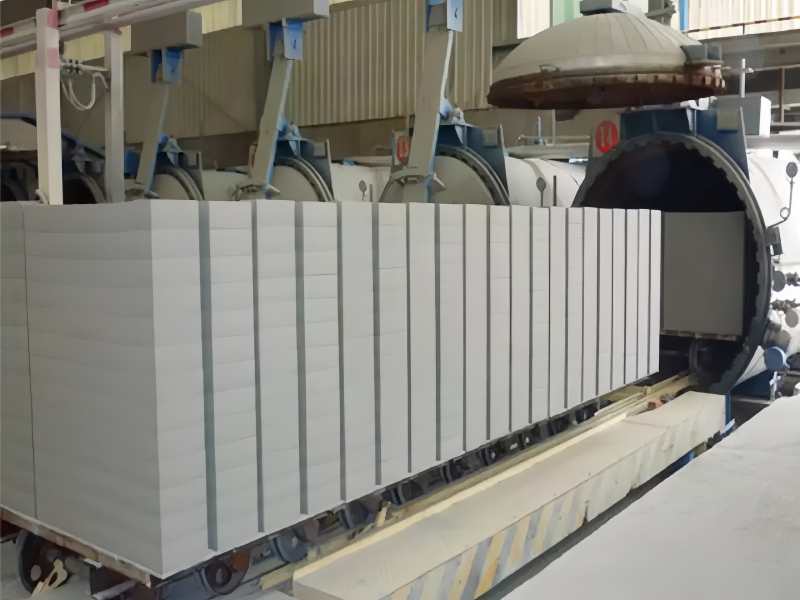
- Autoclave curing system with boiler integration
- Material handling and stacking system
- Electrical control system (PLC automation)
- On-site installation supervision
- Commissioning and operator training
The key principle is system integration, ensuring stable output, controlled energy consumption, and predictable product quality.
Delivery Time & Installation Process
The delivery and execution of an AAC factory project typically follow a structured engineering timeline. While exact duration depends on capacity and site conditions, a standard turnkey project includes the following phases:
1. Engineering Design Phase (30–60 days)
- Process design and capacity planning
- Factory layout and equipment configuration
- Utility and energy system design (steam, power, water)
2. Manufacturing Phase (60–120 days)
- Equipment fabrication and quality inspection
- Pre-assembly testing of key systems
- Packing and shipment preparation
3. Installation Phase (60–90 days)
- Civil foundation coordination
- Equipment installation and alignment
- Electrical and piping integration
4. Commissioning & Training (15–30 days)
- Dry and wet system testing
- Trial production runs
- Operator training and process optimization
Factory Cost Breakdown
AAC factory investment is typically evaluated on a system-level CAPEX model, not just equipment price. Below is a more realistic breakdown used in EPC budgeting.
| Cost Component | Scope | Typical Share | Engineering Notes |
|---|---|---|---|
| Production Equipment | Cutting system, autoclaves, batching, mixers, conveyors | 55–65% | Core driver of capacity and product quality |
| Civil Engineering | Workshop, foundations, steel structure, utilities | 20–30% | Strongly affected by local construction standards |
| Utilities & Energy System | Boiler, steam piping, power distribution | 8–15% | Direct impact on operating cost per m³ |
| Installation & Commissioning | Assembly, calibration, training | 5–10% | Determines startup stability |
Profitability of AAC Factory Investment
AAC production profitability is driven by a simple logic:
Profit = Production Volume × (Selling Price – Unit Production Cost)
But in engineering reality, the unit production cost is the real control variable, not selling price.
1. Typical Cost Structure (Per m³ Output)
| Poste de coût | Impact Level |
|---|---|
| Raw materials (cement, lime, fly ash) | High |
| Steam energy (autoclave system) | Very High |
| Electricity (grinding + cutting) | Moyen |
| Labor | Moyen |
| Maintenance & wear parts | Low–Medium |
2. What Actually Determines ROI
A well-designed AAC factory improves profitability through:
- Higher autoclave utilization efficiency
- Lower steam consumption per m³
- Reduced cutting waste rate
- Stable 90–95% capacity utilization
- Lower labor dependency via automation
3. Practical ROI Range (Industry Reference)
- Small scale (100k m³): moderate ROI, higher unit cost
- Medium scale (150k m³): stable ROI, balanced risk
- Large scale (300k m³): highest ROI potential if fully utilized
Our Case Study
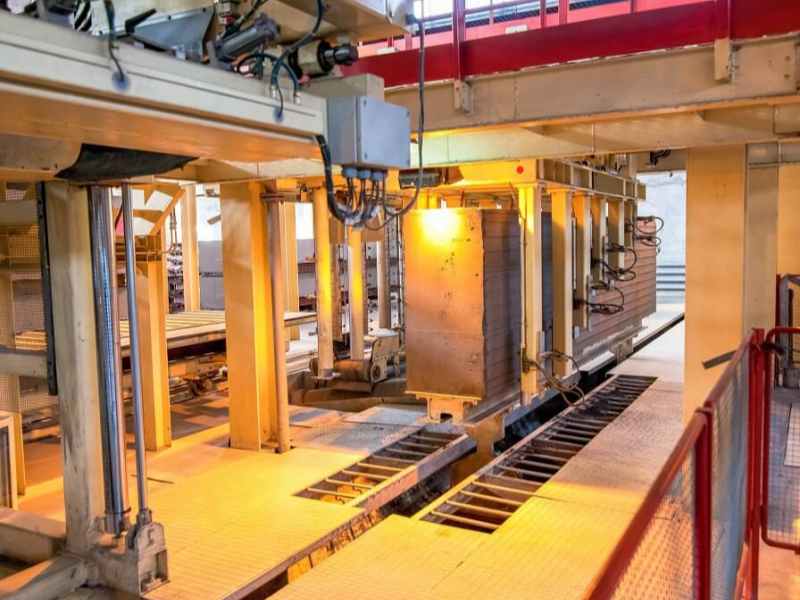
In Russia, a small-scale AAC production line (20,000 m³/year) was delivered to support a local construction materials supplier entering the lightweight block market. The main objective was low investment entry with stable regional supply under cold climate conditions.
Key engineering adjustments included:
- Reinforced insulation design for low-temperature operation
- Optimized steam system for energy stability in winter conditions
- Compact layout suitable for limited industrial space
- Simplified automation for easier local operation and maintenance
After commissioning, the plant achieved stable production for regional housing projects, with consistent block quality and reduced operational complexity.

In Uzbekistan, a 20,000 m³/year AAC block making line was supplied for a small industrial investor upgrading from manual block production. The focus was fast deployment and low operational barrier.
Project configuration included:
- Basic batching and mixing system
- Compact cutting and molding section
- Standard autoclave curing system
- Simplified control system for operator-friendly operation
The system was designed for quick installation and training, enabling the client to start production shortly after setup and gradually expand into the local construction supply chain.
What We Provide
Our engineering team supports full project development, including:
- Feasibility study and capacity planning
- Customized factory layout design (2D/3D)
- Detailed equipment configuration proposal
- Energy consumption and ROI analysis
- EPC turnkey execution plan