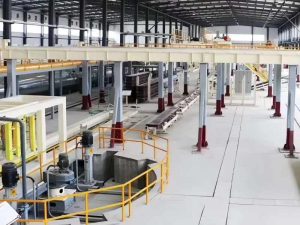
Why Choose a Semi-Automatic AAC Block Plant?
A customized semi-automatic AAC block plant offers an ideal entry solution for construction material manufacturers and investors who want to produce aerated concrete blocks with balanced automation, lower investment cost, and reliable performance. Semi-automatic plants bridge the gap between manual setups and fully automatic lines, delivering improved efficiency while keeping capital expenditure manageable.
Whether you are launching your first AAC block production facility or expanding existing capacity, this solution provides flexibility and strong market adaptability.
What Is a Customized Semi-Automatic AAC Block Plant?


A customized semi-automatic AAC block plant is a tailored production system designed to produce high-quality autoclaved aerated concrete (AAC) blocks with partial automation. Unlike fully automatic plants that rely on full mechanization, semi-automatic lines combine automated core processes with controlled manual operations, optimizing productivity and investment cost.
This type of plant is widely preferred by:
- Small and medium-sized enterprises
- Real estate developers entering block production
- Local distributors diversifying product offerings
- Traditional brick manufacturers upgrading to lightweight AAC blocks
Key Advantages of a Semi-Automatic AAC Block Plant
1. Balanced Investment and Output
Semi-automatic AAC block plants require lower upfront investment compared to fully automated systems, while delivering consistent block quality and reliable throughput. Investors can customize plant capacity to match market demand without over-investing in unnecessary automation.
2. Operational Flexibility
This plant type uses a combination of automated and manual processes, providing:
- Quick adaptation to varied block specifications
- Reduced reliance on expensive specialized labor
- Simple maintenance and operator training
This flexibility makes it easier to manage production variations and seasonal demand.
3. Cost-Effective Production
By automating essential steps like batching, mixing, and cutting while retaining manual oversight for auxiliary processes, semi-automatic systems achieve:
- Lower labor cost
- Reduced energy consumption
- Minimized maintenance expense
These aspects make semi-automatic AAC block production more cost-efficient in many markets.
Core Components of a Customized Semi-Automatic AAC Block Plant
Despite partial automation, a semi-automatic plant includes all critical systems needed for efficient manufacturing:
Raw Material Handling
Efficient feeding, weighing, and storage systems for cement, sand or fly ash, lime, gypsum, and aluminum powder provide consistent material supply.
Batching and Mixing Units
Accurate batching and high-speed mixers ensure uniform slurry mixture, which directly impacts final block strength and performance.
Pouring and Molding
Semi-automated pouring systems fill the molds precisely, while experienced operators manage workflow transitions.
Cutting and Finishing Equipment
CNC or semi-automatic cutting machines deliver uniform block dimensions, reducing waste and improving product appearance.
Autoclave Curing System
High-pressure steam autoclaves cure blocks to solidify strength and provide the cellular structure required for lightweight performance.
Handling and Stacking Solutions
Conveyors and stackers streamline material flow and reduce manual transport labor.
Production Capacity and Investment Considerations
Customized semi-automatic AAC block plants can be configured based on production goals:
- Entry-Level Capacity: Ideal for startups and smaller markets
- Mid-Range Capacity: For established manufacturers looking to expand
- Scalable Layouts: Designed for future upgrades and automation integration
Real-World Applications of AAC Blocks
Blocks produced with customized machinery are suitable for a wide spectrum of construction purposes, including:
- Bâtiments résidentiels – partition and exterior walls
- Commercial spaces – offices, hotels, retail centers
- Installations industrielles – factories, warehouses, workshops
- Institutional structures – hospitals, schools, public infrastructure
- Acoustic and fire-resistant constructions – auditoriums and multi-story developments
The versatility of AAC blocks makes them a preferred material in contemporary construction worldwide.mally efficient, and easier to install compared to traditional bricks.

How to Choose the Right Semi-Automatic AAC Block Plant
When selecting a customized semi-automatic AAC block plant, consider:
Production Requirements
Evaluate annual output goals and choose a configuration that balances investment and return.
Niveau d'automatisation
Semi-automatic plants offer cost advantages, but ensure automation covers core production steps.
Supplier Support
Reliable suppliers provide turnkey services — including plant design, installation, commissioning, and operator training.
Cost of Ownership
Factor in energy consumption, maintenance, labor costs, and raw material availability to forecast long-term profitability.
Why Partner With Us for Your Customized Plant

As an experienced AAC machinery manufacturer and project partner, we offer:
- Tailor-made plant design based on your production goals
- High-quality machinery and components
- Complete turnkey installation and commissioning support
- Operator training and technical service
- After-sales spare parts and maintenance support
Our customized semi-automatic AAC block plants are engineered to deliver reliable performance, cost-effective production, and consistent block quality.
Ready to Start Semi-Automatic AAC Block Production?
A customized semi-automatic AAC block plant combines cost-efficiency, flexibility, and industrial performance — making it an excellent choice for manufacturers targeting expanding construction markets.
Contact us today to discuss your requirements and receive a detailed project proposal, including capacity options, plant layout, and investment analysis. Build smart, grow steadily, and enter the AAC block industry with confidence.