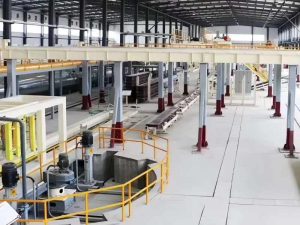
In response to rising construction activity in Uganda — driven by urbanization, infrastructure investment, and affordable housing programs — a local building materials group placed an order for a 100,000 m3 per year AAC plant to Uganda. This turnkey solution enables the production of autoclaved aerated concrete blocks, lightweight panels, and masonry products that deliver high thermal insulation, reduced weight, and faster build cycles.
With Uganda’s construction industry becoming more competitive, this AAC plant empowers investors and manufacturers to scale up production while reducing unit cost and improving product quality.
Client Background: Strategic Expansion by a Ugandan Enterprise
The customer for this project is a rapidly growing Ugandan building materials company headquartered in Kampala, specializing in masonry products and prefabricated elements. Unlike first‑time purchasers, this company had previously invested in small‑scale block machines and found them insufficient to meet new demand from real estate developers and government tenders for energy‑efficient wall systems.
This second collaboration came through a referral from a partner in the regional construction supply network, who recognized the company’s need for higher capacity and recommended our AAC plant solutions tailored for East African conditions.
The customer’s objectives included:
- Increasing annual block output with consistent quality,
- Reducing long lead times for construction materials,
- Competing with imported AAC products,
- Supporting major projects in Kampala, Entebbe, Jinja, and Mbale.

Why Uganda Needs a 100,000 m³ AAC Block Plant
1. Urban Growth and Housing Demand
Uganda’s urban population is expanding rapidly. Cities like Kampala, Mukono, and Gulu are experiencing increased demand for residential housing, commercial buildings, and educational facilities. Local contractors require reliable supplies of lightweight, energy‑efficient masonry materials to deliver quality construction on schedule.
2. Cost Efficiency and Material Performance
AAC blocks offer multiple advantages:
- Lightweight and easy to install — reduces labor time and transport cost
- Excellent insulation properties — lowers building energy consumption
- Uniform dimensions and high compressive strength — improves build quality
For Ugandan builders focused on cost‑effectiveness and performance, AAC blocks outperform traditional clay bricks and concrete blocks.
3. Economic and Environmental Considerations
With sustainability gaining importance, construction projects increasingly seek materials that:
- Minimize waste
- Reduce carbon footprint
- Improve building energy efficiency
AAC block plants support these goals while helping local producers capture market share from imported products.
Project Highlights: What the 100,000 m³ AAC Plant Includes
Our turnkey solution delivered for Uganda includes:
Complete AAC Block Manufacturing Line
- PLC‑controlled batching and mixing system
- High‑pressure autoclave
- Automated cutting machine for panels and blocks
- Curing racks and stacking systems
- Conveyors and steam supply systems
Installation, Training & After‑Sales Support
- On‑site installation and commissioning by experienced engineers
- Operator training emphasizing safety and workflow efficiency
- Maintenance guidance and remote technical support
These features ensure the plant operates reliably and achieves optimal production efficiency from day one.
Core Benefits for Ugandan Builders and Investors
High Production Capacity
With 100,000 m³ per year capacity, the plant can:
- Support multiple construction projects concurrently,
- Fulfill bulk orders from contractors and developers,
- Reduce dependency on imported AAC products.
Improved Profit Margins
Large volume production lowers the unit cost of AAC blocks and positions the business to offer competitive pricing in the Uganda market.
Local Market Advantage
By producing AAC blocks locally, the company gains strategic advantages:
- Faster delivery times,
- Reduced logistics costs,
- Stronger customer relationships in major urban centers.
Project Impact and Future Outlook
The 100,000 m³ AAC plant has enabled the Ugandan customer to:
- Meet local demand with high‑quality AAC products,
- Enter new market segments including affordable housing and public infrastructure,
- Strengthen competitive positioning in East Africa.
As Uganda continues to industrialize and urbanize, demand for lightweight, energy‑efficient building materials will grow — making AAC block production a long‑term, sustainable business opportunity.
Why Choose Us

Experienced Provider: Years of AAC plant deliveries to international markets
Turnkey Solutions: From design and equipment supply to commissioning and training
Local Adaptation: Equipment configured for Tanzania’s materials and conditions
Practical Training: Operator and maintenance training focused on production realities
Reliable Support: Ongoing technical support and expansion guidance
Interested in Building an AAC Block Plant?
If you are considering an AAC block plant, contact us for feasibility analysis, plant layout planning, and investment guidance. Our team will help you turn your project goals into a stable, profitable AAC block manufacturing operation tailored to your market.