For a 100,000–200,000 m³/year medium flyash AAC block plant, the typical Medium Flyash AAC Block Plant Price range is: USD 200,000 to USD 1,000,000.
The reason for this wide range is simple: plant configuration, automation level, autoclave specification, and export standards differ significantly from project to project.
Reference Investment Overview
| Capacity | Automation | Estimated Investment |
|---|---|---|
| 100,000 m³/year | Semi-automatic | USD 200,000 – 400,000 |
| 150,000 m³/year | Semi / Full automatic | USD 350,000 – 650,000 |
| 200,000 m³/year | Fully automatic | USD 600,000 – 1,000,000 |
This typically includes:
- Complete production line equipment
- Cutting system
- Autoclave system
- PLC control system
- Basic installation guidance
Civil construction, raw material silos, boiler house construction, and local utilities may be separate, depending on the contract scope.
What Is a Medium Flyash AAC Block Plant?
A medium capacity flyash AAC block plant is designed to produce 100,000–200,000 cubic meters per year using flyash as the primary silica material.
In practical terms, that means:
- Daily output: approximately 300–650 m³
- Stable regional supply capability
- Suitable for medium-sized construction markets
This capacity level is ideal for:
- Expanding cities
- Government housing programs
- Developers building mid-scale projects
- Investors entering the AAC industry for the first time
It offers a balance between manageable investment and meaningful production scale.

How the Production Process Works
Understanding the process helps you understand the price.
1 Raw Material Preparation
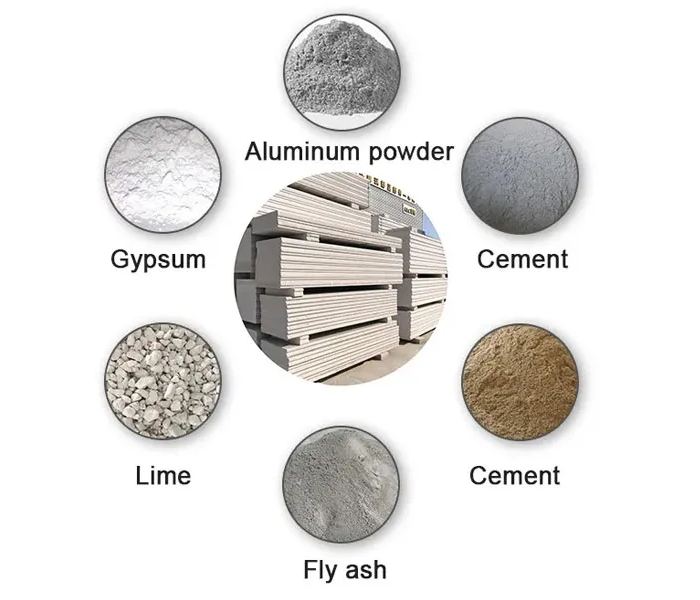
Main materials include:
- Flyash
- Lime
- Cement
- Gypsum
- Aluminum powder
- Water
Flyash is stored in silos and transported automatically to the batching system. Accurate weighing directly affects final block strength and density.
2 Mixing and Casting
Materials are precisely weighed and mixed into slurry. Aluminum powder creates a chemical reaction that forms the porous structure.
Stability in this stage determines product quality consistency.
3 Pre-Curing
After casting, the material expands inside molds. Temperature and humidity control during pre-curing are critical for dimensional stability.
4 Cutting
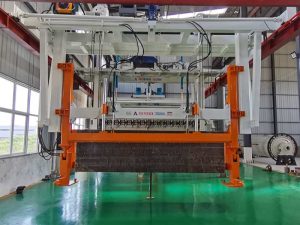
The semi-hardened cake is cut by horizontal and vertical cutting machines into precise block dimensions.
High-quality cutting systems reduce waste and improve block accuracy — one of the major differences between low-cost and professional plants.
5 Autoclaving
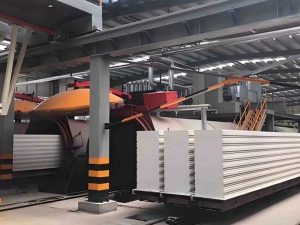
Blocks are steam-cured under high pressure:
- Pressure: 1.2–1.3 MPa
- Temperature: 180–200°C
- Duration: 8–12 hours
Autoclave quality is a decisive factor in plant price and long-term safety.
6 Finished Product Handling
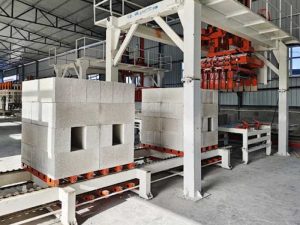
Blocks are separated, stacked, and packed for delivery.
Equipment Configuration in a Medium AAC Plant
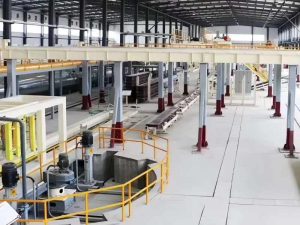
A standard plant typically includes:
Raw Material Section
- Flyash silos
- Screw conveyors
- Electronic weighing system
Mixing & Casting Section
- Slurry mixer
- Pouring system
- Mold circulation system
Cutting Section
- Tilting crane
- Horizontal & vertical cutting machine
- Waste slurry recycling
Autoclave Section
- Autoclaves
- Steam distribution pipeline
- Boiler (optional EPC scope)
Control System
- PLC central control
- Touchscreen monitoring
- Electrical cabinets
Automation level significantly influences price and long-term labor cost.
What Really Determines the Plant Price?
1 Capacity Level
A 200,000 m³ plant requires:
- More molds
- More autoclaves
- Larger cutting systems
- Stronger steam supply
Higher capacity means higher equipment and infrastructure investment.
2 Autoclave Specification
Autoclaves account for a large portion of total cost.
Key parameters include:
- Diameter (2.0m–2.85m)
- Length (31m–42m)
- Steel thickness
- Safety standard compliance
Lower price often means thinner steel or reduced structural margin. This is not visible at first glance but becomes critical over time.
3 Automation Level
Semi-automatic systems:
- Lower upfront cost
- Higher labor requirement
Fully automatic systems:
- Higher initial investment
- Lower long-term labor cost
- More stable production
- Better product consistency
For export-oriented or high-volume markets, full automation is usually more economical long term.
4 Control System Stability
A stable PLC system ensures:
- Accurate batching
- Stable expansion
- Minimal block cracking
- Reduced downtime
Unreliable control systems can cause hidden losses every day.
5 Energy System Configuration
Energy choice affects both investment and operating cost:
- Coal-fired boiler
- Gas-fired boiler
- Biomass boiler
Local fuel price and availability should guide this decision.
Investment Structure Breakdown
A typical cost distribution looks like this:
| Component | Share of Investment |
|---|---|
| Autoclaves | 25–35% |
| Cutting system | 15–20% |
| Raw material system | 10–15% |
| Boiler & steam system | 15–20% |
| Control system | 8–12% |
| Installation | 5–10% |
Knowing this structure helps you evaluate quotations objectively.
Operating Cost Analysis
Investment is only one part of the picture. Profitability depends on operating cost.
Production Cost per m³
In most markets:
- Raw materials: 45–60%
- Energy: 15–25%
- Labor: 10–20%
- Maintenance: 5–10%
Typical production cost ranges:
USD 25 – 45 per m³ (depending on region)
Labor Requirement
- Semi-automatic: 20–35 workers
- Fully automatic: 12–20 workers
Automation significantly reduces ongoing expense.
Energy Consumption
- Steam: approx. 220–260 kg per m³
- Electricity: 25–35 kWh per m³
Efficient plant design reduces waste and improves margins.
Return on Investment
In many developing construction markets:
- Selling price: USD 50–80 per m³
- Gross margin: USD 20–35 per m³
With stable demand, a 200,000 m³/year plant can achieve:
- Strong annual cash flow
- Payback period: approximately 3–5 years
Actual ROI depends on local block pricing and raw material cost.
Fair Price vs. Lowest Price
It is natural to compare quotations. However, the lowest price often hides compromises:
- Thin autoclave steel
- Low-grade electrical components
- Inaccurate cutting systems
- No real after-sales support
A flyash AAC block plant is a long-term industrial asset. Small compromises at purchase stage can result in years of inefficiency.
A fair and transparent price ensures:
- Proper engineering standards
- Reliable automation
- Technical training
- Spare parts support
- Long-term stability
Why Work with a Direct Manufacturer and EPC Supplier
As a factory-direct equipment manufacturer and turnkey EPC supplier, we provide:
- Engineering layout design
- Equipment manufacturing in-house
- Customized configuration
- Global export packaging
- Installation guidance
- Production formula support
Working directly with the manufacturer improves communication clarity and cost transparency.
Is a Medium Plant the Right Choice for You?
A 100,000–200,000 m³/year plant is suitable when:
- Regional demand is strong but not saturated
- You want controlled investment risk
- You prefer gradual market expansion
- You want scalable growth potential
It offers a stable entry point without overcapacity pressure.
How to Receive an Accurate Quotation
To prepare a realistic investment plan, we typically need:
- Target annual capacity
- Flyash chemical composition
- Local fuel type and price
- Available land size
- Preferred automation level
- Budget range
Based on this, we can provide:
- Plant layout drawing
- Equipment configuration list
- Detailed quotation
- Operating cost estimation
Start Your Medium Flyash AAC Project with Confidence
Investing in a medium flyash AAC block plant is a strategic decision. It is not only about equipment — it is about building a stable production system that can serve your regional construction market for years.
If you are planning a 100,000–200,000 m³/year flyash AAC block plant, we can help you evaluate configuration options, compare investment levels, and prepare a customized solution that matches your market and budget.
Send us your project details. We will prepare a clear, transparent proposal tailored to your needs — so you can move forward with confidence and clarity.