
Aerated Concrete Production Facility: Engineering Design & Process System
An aerated concrete production facility is a fully integrated industrial system designed to convert raw siliceous materials into lightweight, porous concrete blocks through a controlled combination of chemical reaction, mechanical processing, and high-pressure steam curing. From an engineering perspective, it is not a single production line but a multi-system manufacturing environment where process stability, energy flow, and material handling must operate as one synchronized structure.
Unlike conventional block production, aerated concrete manufacturing relies on precise control of reaction kinetics, temperature curves, and curing pressure profiles. As a result, facility design is fundamentally a process engineering task rather than a mechanical equipment selection exercise.

What Is Aerated Concrete Production Facility?
In technical terms, an aerated concrete production facility refers to a designed industrial system that integrates all stages of AAC manufacturing into a continuous, controlled process flow—from raw material preparation to final autoclave curing and product handling.
It typically includes:
- Raw material processing and slurry preparation units
- Automated batching and mixing systems
- Casting and pre-curing zones
- Precision cutting systems
- High-pressure autoclave curing section
- Finished product handling and storage logistics
From an engineering standpoint, the key distinction is:
- Equipment line: Individual machines performing isolated tasks
- Production facility: A coordinated system where each process stage is mathematically balanced in capacity, timing, and energy consumption
This system-level integration is what determines whether a plant operates at stable output or suffers from bottlenecks and inefficiencies.
Process Engineering of AAC Facility
The production of aerated concrete is based on a dual-mechanism process: chemical foaming reaction followed by hydrothermal curing.
1. Chemical Process Stage (Foaming & Formation)
In the initial stage, finely ground silica-based materials (sand or fly ash) are mixed with cement, lime, gypsum, and aluminum powder. The aluminum reacts in an alkaline environment, generating hydrogen gas bubbles.
This reaction is highly sensitive to:
- Material fineness and homogeneity
- Mixing temperature and time
- Aluminum dosage precision
The result is a self-expanding slurry that forms a porous internal structure.
2. Mechanical Process Stage (Shaping & Cutting)
Once expansion stabilizes, the semi-solid “green body” undergoes mechanical processing:
- Mold demolding
- Horizontal and vertical wire cutting
- Dimensional calibration
This stage determines the geometric accuracy and surface quality of the final product. Unlike chemical stages, this phase is purely mechanical but highly time-sensitive, as material hardness changes rapidly.
3. Hydrothermal Curing Stage (Autoclave Reaction)
The final stage occurs in autoclaves under high-pressure saturated steam conditions. Here, calcium silicate hydrates are formed, transforming the material into a stable crystalline structure.
Typical conditions:
- Pressure: 1.2–1.3 MPa
- Temperature: 180–200°C
- Cycle duration: 8–12 hours
This stage defines the final strength, durability, and structural stability of the material.
System Integration in Facility Design
A modern aerated concrete production facility is designed as a fully synchronized system rather than independent process units. The performance of the plant depends on how well each subsystem is integrated into a continuous operational flow.
1. Core Integration Principle
The facility operates under a single constraint:
All process stages must be synchronized with the autoclave cycle time.
Since autoclaving is the slowest and most energy-intensive stage, it effectively becomes the takt time reference for the entire production system.
2. Interdependent System Architecture
Key subsystems are engineered to operate in alignment:
- Raw material system → Must ensure consistent slurry quality for stable chemical reaction
- Mixing system → Controls reaction initiation timing
- Casting system → Must match expansion curve precisely
- Cutting system → Operates within a narrow material hardness window
- Autoclave system → Defines production rhythm and capacity ceiling
Any mismatch between these systems results in:
- Bottlenecks in production flow
- Increased waste rate
- Reduced effective capacity utilization
3. Engineering Objective
The primary objective of facility integration is not maximum individual machine performance, but:
Balanced system throughput with minimal energy loss and stable product quality
This is achieved through:
- Capacity matching across all process stages
- Controlled buffer zones between critical operations
- Centralized process synchronization logic (often PLC-based)
Technical Parameters That Matter
In an aerated concrete production facility, process stability is defined by a small set of critical engineering parameters. These parameters directly determine product strength, density consistency, and curing quality. If they are not tightly controlled, downstream variability becomes unavoidable regardless of equipment quality.
Key Parameters
1. Density Control (Fresh & Finished Product)
- Fresh slurry density defines expansion behavior
- Final dry density typically ranges between 500–700 kg/m³ depending on product grade
- Density fluctuation is a primary indicator of process instability
2. Curing Pressure (Autoclave System)
- Standard operating pressure: 1.2–1.3 MPa
- Directly affects crystalline formation (tobermorite structure)
- Pressure instability leads to strength inconsistency across batches
3. Temperature Curve
- Typical curing temperature: 180–200°C
- Heating and cooling ramps must be controlled to avoid internal stress
- Rapid temperature changes increase micro-crack risk
Facility Capacity Engineering (100k–300k)
Capacity design in an aerated concrete facility is not a linear scaling problem—it is a system synchronization problem. Each capacity level requires a different balance between equipment throughput, autoclave cycles, and material flow stability.
1. Capacity Logic
- 100,000 m³/year
- Entry-level industrial configuration
- Limited autoclave units
- Higher sensitivity to process fluctuation
- 150,000 m³/year
- Balanced configuration
- Standard industrial synchronization model
- Most commonly used EPC design baseline
- 300,000 m³/year
- Fully industrialized system
- Multiple autoclave lines in parallel
- High automation dependency and energy optimization focus
2. Engineering Principle
Capacity scaling is governed by a key constraint:
Autoclave cycle time defines the maximum system throughput.
All upstream systems (mixing, casting, cutting) must be engineered to feed the autoclave rhythm without interruption or overload.
Efficiency & Energy Optimization
Energy efficiency in an AAC facility is primarily determined by the performance of the steam generation and autoclave curing system. Since autoclaving is the most energy-intensive stage, even small design improvements significantly impact operating cost per cubic meter.
Steam System Efficiency Factors
- Boiler thermal efficiency and fuel utilization
- Steam distribution balance across autoclaves
- Condensate recovery and heat reuse
- Pipeline insulation quality and heat loss control
Operational Optimization Logic
Efficiency is achieved not by reducing energy input, but by improving energy utilization per production cycle:
- Maximizing autoclave loading rate per cycle
- Eliminating partial-load curing operations
- Synchronizing batch output with steam cycles
- Reducing idle heating periods
Engineering Case Study

A 90,000 m³/year AAC production facility in Egypt was optimized to address energy inefficiency and inconsistent batch quality caused by unstable raw material characteristics and non-synchronized process timing.
Key engineering interventions included:
- Recalibration of slurry density control based on local sand composition
- Optimization of batching-to-casting timing window
- Improved autoclave loading strategy to increase cycle utilization
- Adjustment of steam distribution for uniform curing conditions
After optimization, the facility achieved:
- Improved production stability across all shifts
- Reduced energy consumption per cubic meter
- Higher consistency in compressive strength performance

In Turkey, a medium-scale AAC facility required optimization due to high operating cost and uneven autoclave utilization in a competitive energy-sensitive market.
Engineering adjustments included:
- Restructuring production scheduling around autoclave cycle efficiency
- Improving cutting system synchronization to reduce idle time
- Enhancing steam recovery efficiency and insulation performance
- Balancing automation levels across material handling systems
Post-optimization results showed:
- Improved system-wide throughput efficiency
- Reduced energy cost per unit output
- Stabilized product quality under continuous production
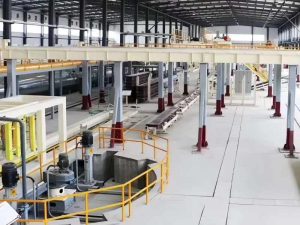
Related Autoclaved Aerated Concrete Plant




Design Your Facility with Engineers
An aerated concrete production facility is not a standardized product—it is a project-specific engineering system that must be designed around raw materials, capacity targets, energy conditions, and market requirements.
Our engineering team provides full technical support, including:
- Process flow design and capacity modeling
- Facility layout and system integration planning
- Energy optimization and steam system design
- EPC execution strategy and investment evaluation
To ensure technical feasibility and investment stability, we recommend starting with a complete engineering design package before equipment selection.
If you share your project requirements (capacity, location, raw materials), our team can prepare a custom facility engineering proposal with layout and process simulation within 24–48 hours.