
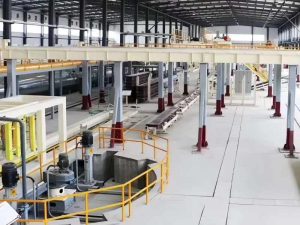
Recently, our company successfully completed the trial operation of a 100,000 cubic meter per year aerated concrete block (AAC) factory in Tanzania. This marks the first time our AAC block production line has been exported to Tanzania.
This AAC Block Plant to Tanzania 100,000m3/Year not only integrates highly efficient and energy-saving core technologies but also incorporates customized solutions tailored to the characteristics of local Tanzanian raw materials. Once operational, it will fill the supply gap for high-quality AAC blocks in the region.
This successful launch is not only a significant milestone in our expansion into the African market but also provides valuable experience for future overseas projects in terms of technology transfer and localization services.
What Is an AAC Block Plant to Tanzania 100,000m3 per Year?
An AAC Block Plant to Tanzania 100,000m3 per Year is a complete manufacturing solution designed to produce up to 100,000 cubic meters of Autoclaved Aerated Concrete blocks annually. These blocks are known for their:
- Lightweight structure
- High thermal insulation
- Fire resistance
- Dimensional precision
- Faster installation speeds
The production line typically includes:
- Automated raw material batching and weighing
- High-precision slurry mixing
- CNC cutting systems
- Autoclaves for high-pressure steam curing
- Finished product stacking and packing equipment
This level of automation ensures reliable and continuous block production suitable for regional supply chains in Tanzania and neighboring countries.

Project Background: Why the Client Chose AAC Block Production
The client had been serving housing and infrastructure projects using traditional blocks, but faced increasing pressure from rising labor costs and demand for faster construction cycles. After evaluating several options, they decided to invest in an AAC block plant to upgrade their product range, improve production efficiency, and better meet the requirements of modern construction projects in Tanzania.
Why Tanzania Is an Attractive Market for AAC Block Production
Tanzania’s construction sector has seen steady growth due to:
- Government-sponsored public housing and infrastructure projects
- Private residential and commercial development
- Urbanization in regions like Dar es Salaam, Arusha, and Mwanza
- Increased acceptance of modern building materials
Compared to traditional clay bricks, AAC blocks offer better thermal performance—which is particularly valuable in Tanzania’s tropical climate—and reduced structural weight, making them attractive for large housing and commercial developments.
Market Demand and Growth Potential in Tanzania
Demand for AAC blocks in Tanzania is driven by:
- Large-scale affordable housing programs
- Commercial and hospitality construction
- Institutional buildings like schools and hospitals
- Government and private industrial facilities
Investors considering an AAC block plant to Tanzania 100,000m³/year should note that local demand is often supported by limited supply from existing manufacturers, which presents an opportunity for new high-capacity entrants.
Raw Material Availability and Supply Chain in Tanzania
Reliable raw material access is essential for stable AAC block production. In Tanzania:
- Cement: Produced domestically and supplemented by imports
- Lime and Limestone: Available from regional suppliers or import channels
- Silica Sand: Accessible from local deposits suitable for AAC mix designs
- Aluminum Powder: Supplied by industrial chemical distributors
Local sourcing reduces transportation costs and ensures continuity of production, minimizing reliance on imported inputs.
Site Requirements: Land, Power & Water Utilities
A successful AAC block plant to Tanzania 100,000m³/year requires:
- Industrial land with adequate space for raw material storage, production halls, and packing areas
- Reliable electricity supply; backup generators recommended to protect production continuity
- Sufficient water access for slurry mixing and steam generation
- Good road connectivity for logistics and distribution
Cities with established industrial infrastructure—including Dar es Salaam, Dodoma, and Arusha—are popular choices for plant setup due to connectivity and access to utilities.
Installation, Commissioning & Operator Training
To ensure seamless plant start-up and stable output, professional support is critical for an AAC block plant to Tanzania 100,000m³/year. Our comprehensive services include:
- On-site supervision of equipment assembly
- Sequential commissioning to test each section of the production line
- Operator training focused on real production workflows
- Maintenance guidance to minimize downtime
Training emphasizes practical skills that allow local operators to manage daily production and quality control independently.
Investment Cost & Return Expectations for an AAC Block Plant in Tanzania
Investment considerations for an AAC block plant to Tanzania 100,000m³/year include:
- Equipment procurement and installation costs
- Site preparation and utility connections
- Workforce training and initial operational expenses
- Marketing and distribution planning
Because AAC blocks are increasingly adopted in Tanzania for both private and public projects, investors can position themselves to capture stable demand and achieve favorable unit production costs over time.
Applications of AAC Blocks in Tanzania
Blocks produced by an AAC block plant to Tanzania 100,000m³/year are suitable for a variety of construction scenarios:
- Residential Buildings: Apartments, single-family homes, and mixed-use developments
- Commercial Projects: Offices, retail centers, hotels, and warehouses
- Institutional Facilities: Schools, clinics, and government buildings
- Internal Partition Walls: Non-load-bearing applications where speed and insulation matter
AAC blocks support energy-efficient building design, faster construction cycles, and improved on-site productivity.
Scalability & Expansion Opportunities
A plant configured for 100,000m³/year AAC block production can be expanded as demand grows. Typical upgrades include:
- Additional autoclaves for higher curing capacity
- Upgraded cutting systems for increased throughput
- Expanded storage, packing, and handling facilities
Modular design allows investors to scale production without interrupting current operations.

Porquê escolher-nos

Experienced Provider: Years of AAC plant deliveries to international markets
Turnkey Solutions: From design and equipment supply to commissioning and training
Local Adaptation: Equipment configured for Tanzania’s materials and conditions
Practical Training: Operator and maintenance training focused on production realities
Reliable Support: Ongoing technical support and expansion guidance
Interested in Building an AAC Block Plant?
If you are considering an Fábrica de blocos AAC, contact us for feasibility analysis, plant layout planning, and investment guidance. Our team will help you turn your project goals into a stable, profitable AAC block manufacturing operation tailored to Tanzania’s market.




Frequently Asked Questions
This capacity matches growing construction demand while providing manageable operating costs and supply stability.
Installation and commissioning typically take several months, depending on site readiness and utility availability.
Yes. Practical, on-site training equips local operators to run the plant and perform routine maintenance.