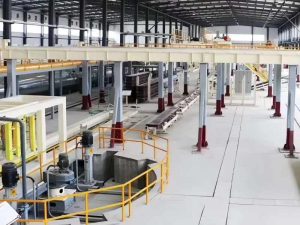
AAC Plant Shipped to South Africa With 80,000m³/Year
In October 2024, our team successfully delivered an 80,000 m³/year AAC Plant Shipped to South Africa. As a global provider of AAC production line solutions with 20+ years of experience, we tailored this project to South Africa’s unique construction market demands
| Project Detail | Specification |
|---|---|
| Country | South Africa (Johannesburg, Gauteng Province) |
| Production Capacity | 80,000 m³/year |
| Plant Type | Semi-automatic Mini AAC Block Manufacturing Plant |
| Client Type | Local construction materials distributor expanding into AAC block production |
| Setup Cost | 850,000 USD (inclusive of equipment, design, and training) |
| Delivery Time | 40 days (from factory to Durban Port) |
| On-Site Installation | 25 days |
| Commissioning | 7 days |

The client had operated a brick and concrete block distribution business for over a decade, supplying major residential and commercial projects in Gauteng. Faced with South Africa’s growing demand for energy-efficient building materials (driven by the government’s National Development Plan 2030) and the declining availability of traditional clay bricks, they chose to invest in an AAC plant. After evaluating 3 global suppliers, they selected our solution for its:
- Compatibility with South Africa’s abundant fly ash (a byproduct of coal power plants) and river sand
- Low initial investment (aligned with their budget for gradual expansion)
- Fast startup timeline (critical for capitalizing on the 2024–2025 construction peak season)
Why AAC Blocks Are Booming in South Africa?
South Africa’s construction industry is undergoing a green transformation, and AAC blocks have emerged as the preferred alternative to traditional clay bricks—here’s why:
- Government Policy Support: The National Development Plan (NDP) prioritizes affordable housing (targeting 1.5 million new homes by 2030) and sustainable construction. AAC blocks qualify for tax incentives under the Section 12J Tax Incentive Scheme for green building projects.
- Energy Efficiency Mandates: South Africa’s SANS 204 energy efficiency standard requires buildings to reduce heat transfer. AAC blocks have a thermal conductivity of 0.12–0.15 W/mK (60% lower than clay bricks), cutting heating/cooling costs for homeowners by 30–40%.
- Raw Material Availability: South Africa produces over 30 million tons of fly ash annually (from power plants like Eskom’s Medupi). Our AAC plant uses 70% fly ash as raw material, lowering costs and supporting circular economy goals.
- Regional Demand Hotspots: High-growth areas like Gauteng (Johannesburg/Pretoria), Western Cape (Cape Town), and KwaZulu-Natal (Durban) are driving AAC demand—especially for mid-rise residential buildings and retail complexes.
For developers, AAC blocks’ 65% lighter weight (vs. clay bricks) reduces structural load, cuts transportation costs by 25%, and speeds up construction by 15–20%—a game-changer in South Africa’s labor-constrained market.
Why the Client Chose an 80,000 m³/Year AAC Plant
For South African investors, an 80,000 m³/year mini AAC plant strikes the perfect balance between demand, cost, and scalability. Here’s why it was the right fit for our client:
Ideal for South African Markets
- Regional Focus: 80,000 m³/year supplies ~5,000 mid-sized homes annually—enough to serve Gauteng’s local demand without overextending distribution networks.
- Land Efficiency: The plant fits on a 70m × 50m plot (common in industrial zones near Johannesburg), avoiding the high cost of large land parcels.
- Workforce Compatibility: Operated by 10–12 local workers (after our training), it aligns with South Africa’s need for job creation while keeping labor costs manageable.
Key Benefits for the Client
- Fast ROI: 1.8–2.2 years (projected), thanks to high AAC block demand and lower raw material costs.
- Scalability: We designed the plant to upgrade to 150,000 m³/year with minimal equipment additions (e.g., extra autoclave, automated palletizer) as their business grows.
- Low Operational Costs: Energy consumption is 22% lower than South African industry averages, and fly ash sourcing costs are 40% less than sand for clay bricks.
Core Equipment of AAC Plant Shipped to South Africa
Every piece of equipment in this AAC Plant Shipped to South Africa was customized to handle South Africa’s raw materials and operational needs—ensuring long-term stability and compliance with local standards (SANS 12153 for AAC blocks):
| Equipment | Specification & Local Adaptation |
|---|---|
| Ball Mill | 2.2m × 7.5m, optimized for grinding South African fly ash (higher silica content than Indian fly ash) |
| Slurry Mixing System | Stainless steel tanks (resistant to corrosive local river sand) with automatic pH monitoring |
| Automatic Batching System | Pre-programmed for SANS 12153 mix ratios (70% fly ash, 15% lime, 10% cement, 5% gypsum) |
| Vertical Cutting Machine | 4.8m cutting bed (fits South Africa’s standard block size: 600×200×100/150/200mm) |
| Autoclave | Φ2.4m × 30m, high-pressure design (1.2MPa) to counteract Johannesburg’s high altitude (1,753m) |
| Steam Boiler System | Biomass-fired (uses local sugarcane bagasse—cheaper than coal, supports green certifications) |
| Finished Block Packing System | Semi-automatic (reduces reliance on skilled labor, easy to operate for local workers) |
This configuration ensures consistent block quality: after commissioning, the plant achieved a 96% qualified rate—well above South Africa’s minimum standard of 90%.
Export Process of AAC Plant Shipped to South Africa
We streamlined the export process to avoid delays (a common pain point for African projects) and ensure compliance with South African customs and standards:
1. Pre-Production: Localization First
- Raw Material Testing: We sampled fly ash from Eskom’s Tutuka Power Station and river sand from the Vaal River to adjust mix formulas—critical for meeting SANS 12153 strength requirements (≥3.5 MPa compressive strength).
- Block Size Customization: Modified molds to produce South Africa’s most in-demand sizes (600×200×150mm for load-bearing walls, 600×200×100mm for non-load-bearing).
- Layout Design: Adapted the plant layout to fit the client’s existing industrial plot in Johannesburg, including rainwater drainage (to handle South Africa’s summer storms).
2. Manufacturing & Quality Checks
- 35-day equipment production cycle (with weekly video updates for the client).
- Independent third-party inspection (by SGS South Africa) to verify compliance with IEC 60204 electrical standards and ISO 9001 quality management.
3. Shipping & Logistics
- Shipped via Durban Port (South Africa’s busiest container port) in 8×40HQ containers.
- Provided full export documentation:
- Certificate of Origin (COO) (approved by the South African Revenue Service)
- SANS 12153 Compliance Certificate
- Packing List, Commercial Invoice, and Bill of Lading
- Spare parts kit (includes 6 months of critical components like cutting wires and gaskets)
On-Site Installation & Training: Empowering Local Teams
To ensure the client could operate the plant independently, our team provided end-to-end support:
Installation (25 Days):
- Combined remote guidance (for electrical setup) and on-site support (2 engineers from our Cape Town office) to comply with South Africa’s Occupational Health and Safety Act (OHSA).
- Coordinated with local contractors for civil works (e.g., autoclave foundation) to speed up progress.
Training (10 Days):
- Trained 12 local workers (including operators, maintenance staff, and quality inspectors) on:
- Safe operation of the autoclave and steam boiler (per OHSA regulations).
- Raw material quality control (how to test fly ash moisture content).
- Troubleshooting common issues (e.g., slurry viscosity adjustments).
- Provided a localized training manual (in English and Zulu) with step-by-step videos.
Post-Commissioning Performance: Exceeding Expectations
Since launching in November 2024, the AAC plant has delivered consistent results—helping the client capture market share quickly:

| Performance Metric | Result |
|---|---|
| Daily Output | 220–240 m³ (meets 80,000 m³/year target, 10% above projection) |
| Block Density | 580–620 kg/m³ (ideal for South African load-bearing wall requirements) |
| Qualified Rate | 96% (exceeds SANS 12153’s 90% minimum) |
| Energy Consumption | 23% lower than the client’s initial estimate (thanks to biomass boiler) |
| Customer Acquisition | Secured 3 major contracts (2 residential projects in Pretoria, 1 retail center in Johannesburg) within the first month. |
What Our South African Client Says?
“Choosing this 80,000 m³/year AAC plant was our business’ best decision. The team tested our local fly ash thoroughly and tailored a solution that fits our budget and land perfectly. Installation was on time, and the training made it easy for our workers to adapt—we produced qualified blocks just 7 days post-commissioning. Now, we’re securing contracts we couldn’t before, thanks to high demand for green AAC blocks. We’re already planning expansion and will absolutely partner with them again.”
Why Choose Us?
For AAC plant investors in South Africa, partnering with a provider who understands local markets is critical. Here’s why we’re the trusted choice:
- Local Expertise: We’ve completed 12 AAC plant projects across South Africa, Nigeria, and Kenya—we know how to navigate local regulations (SANS, OHSA) and raw material challenges.
- Cost-Effective Solutions: Our mini AAC plants (30,000–100,000 m³/year) start at 100,000 USD—perfect for new investors or distributors looking to expand.
- Turnkey Support: From raw material testing to post-launch maintenance, we handle every step—no need to coordinate multiple vendors.
- Scalability: All our plants are designed to grow with your business (e.g., 80,000 m³/year → 150,000 m³/year) without major overhauls.

Start Your AAC Block Manufacturing Plant?
Whether you are planning a small, medium, or large-scale AAC factory, we can provide complete solutions based on your land, budget, and market demand.
Contact us now to get a free feasibility study & detailed quotation. Our engineers will design the most suitable AAC plants for your needs.