
Overview of AAC Production Process
AAC production is a continuous process combining chemical reaction, mechanical handling, and high-pressure curing.
At system level, it always follows this chain:
Raw material preparation → Mixing → Casting → Pre-curing → Cutting → Autoclaving → Finished blocks
What matters is not only each step—but the transition between steps.
If one stage slows down, the entire line will accumulate bottlenecks.

Is Your Raw Material Suitable for AAC Production?
Before selecting machinery, raw material condition is always the first checkpoint.
In most projects, we evaluate three key factors:
- Fly ash or sand availability
- Fineness and chemical stability
- Consistency of supply
| Rohmaterial Typ | Processing Requirement | System Impact |
|---|---|---|
| Flugasche | Lower grinding load | Stable reaction |
| Sand | Requires ball milling | Higher energy consumption |
| Mixed materials | Custom adjustment needed | System tuning required |
We have seen projects fail not because of machinery, but because raw material variation was ignored during planning.
Step-by-Step Production Machinery
Here is how a standard AAC production line operates in practice:
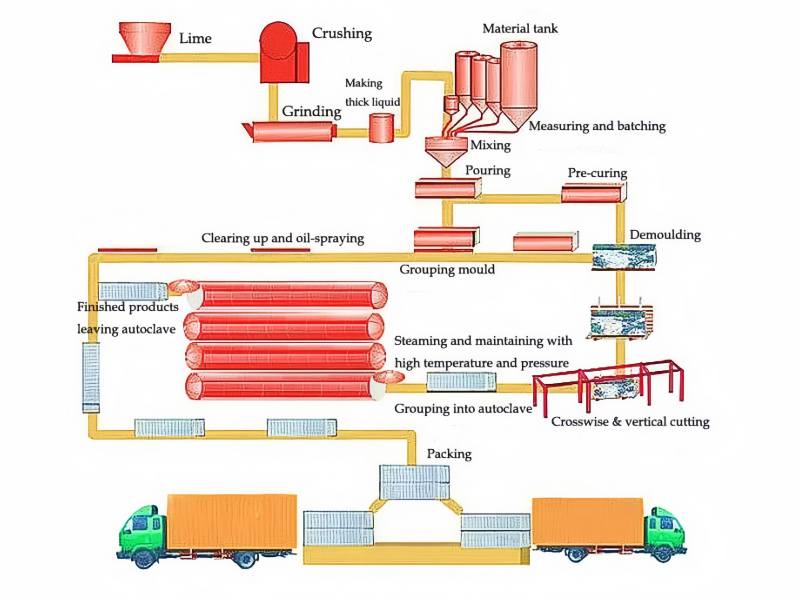
1. Vorbereitung des Rohmaterials
Grinding and slurry formation define the stability of the entire process.
2. Mixing System
Cement, lime, slurry, and aluminum powder are mixed under controlled timing.
3. Casting
The mixture is poured into molds where initial expansion begins.
4. Pre-curing
Blocks reach a semi-solid state suitable for cutting.
5. Cutting System
This stage determines dimensional accuracy.
6. Aushärtung im Autoklaven
High-pressure steam reaction finalizes strength and structure. Each step has a fixed timing window. If one step is delayed, downstream processes are directly affected.
Process Flow Diagram Explanation
In real plant design, we always emphasize one principle:
The plant is not a sequence of machines—it is a synchronized flow system.
A typical production flow looks like this:
Raw materials → Slurry system → Mixing → Mold casting → Pre-curing chamber → Cutting system → Autoclaves → Finished storage
The most sensitive points in this flow are:
- Transition from casting to pre-curing
- Transition from pre-curing to cutting
- Autoclave cycle synchronization
If these three points are balanced, the plant runs smoothly. If not, bottlenecks appear immediately.
Main Types in AAC Block Production Machinery Process
1. Ausrüstung zur Handhabung von Rohstoffen
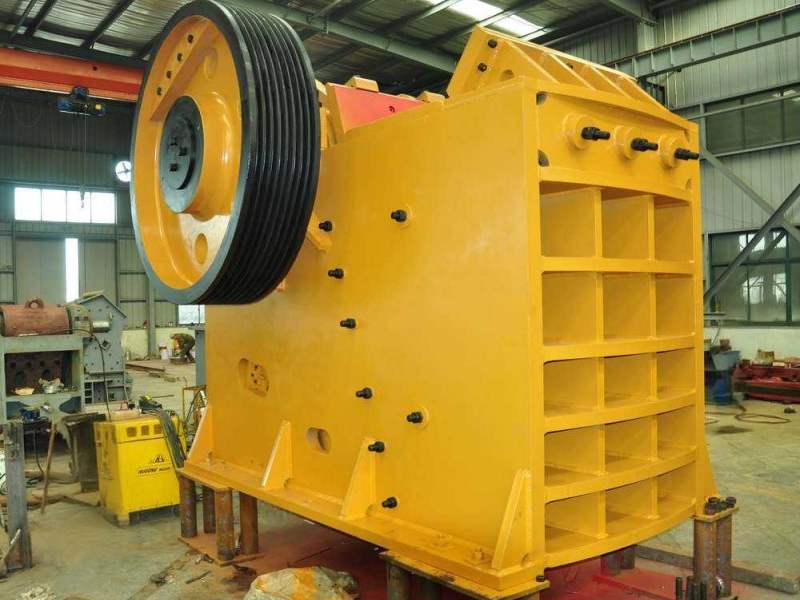
Brecher: Zerkleinert Rohstoffe wie Sand und Kalk auf die gewünschte Korngröße. Backenbrecher werden für harte Materialien und Prallbrecher für die Feinzerkleinerung eingesetzt.
Screener: Das Vibrationssieb entfernt Verunreinigungen und stellt sicher, dass die Partikel des Rohmaterials eine einheitliche Größe haben.
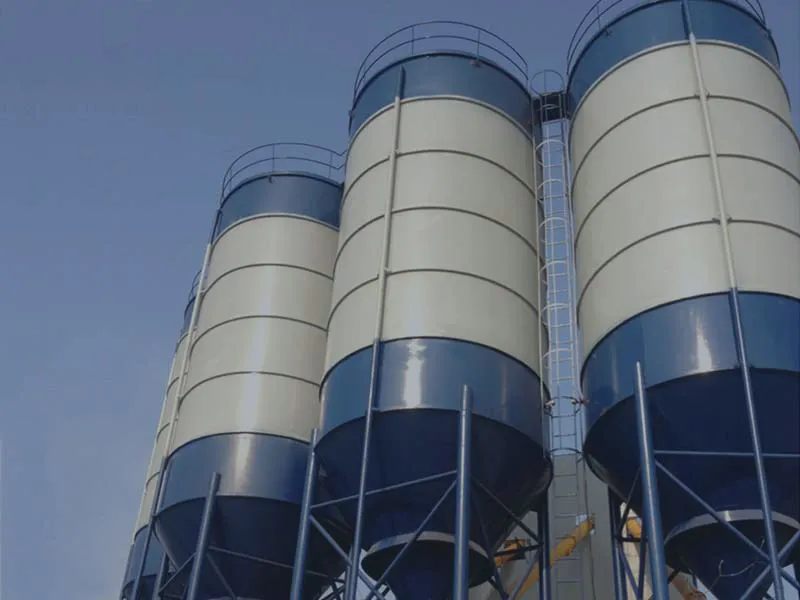
Lager-Silo: Lagert vorbehandelte Rohmaterialien. Er verfügt über einen Füllstandsmesser und eine Staubabsaugung, um die Produktion kontinuierlich aufrechtzuerhalten und die Anforderungen des Umweltschutzes zu erfüllen.
Waage: Band- oder Spiralwaagen messen die Rohmaterialmengen genau, um Rezepturfehler zu minimieren.
2. Misch- und Verschäumungsanlagen
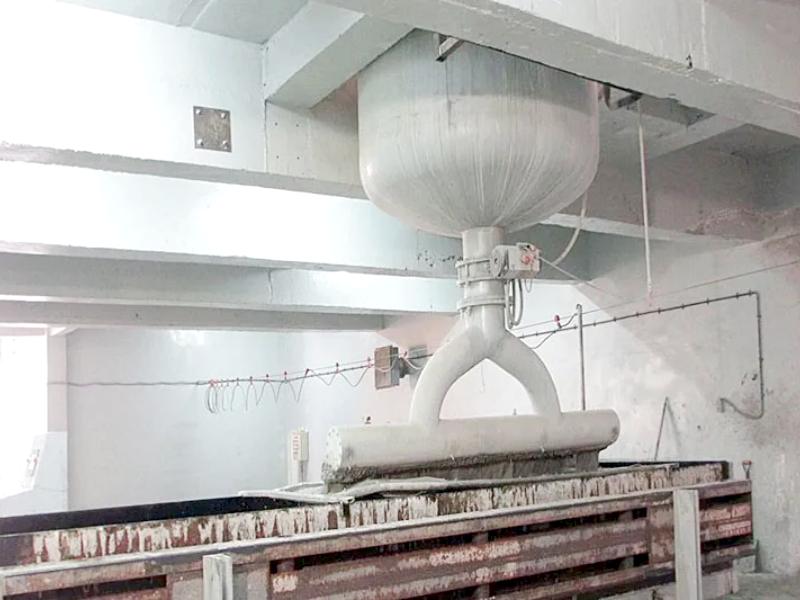

Zwangsmischer: Mischt feste Rohstoffe und Wasser mit hoher Geschwindigkeit zu einem gleichmäßigen Schlamm, der die Grundlage für die Schaumbildung bildet.
Aluminium-Pulver-Mischbehälter: Mischt Aluminiumpulversuspension bei niedriger Geschwindigkeit, um Sedimentation zu verhindern und eine gleichmäßige Dispersion zu gewährleisten.
Schäumendes System: Die Aluminiumpulversuspension wird in einem bestimmten Verhältnis eingespritzt, um mit dem Schlamm zu reagieren und Blasen zu erzeugen, die dann mit dem Mischer zur automatischen Steuerung verbunden werden.
3. Guss- und Formgebungsausrüstung
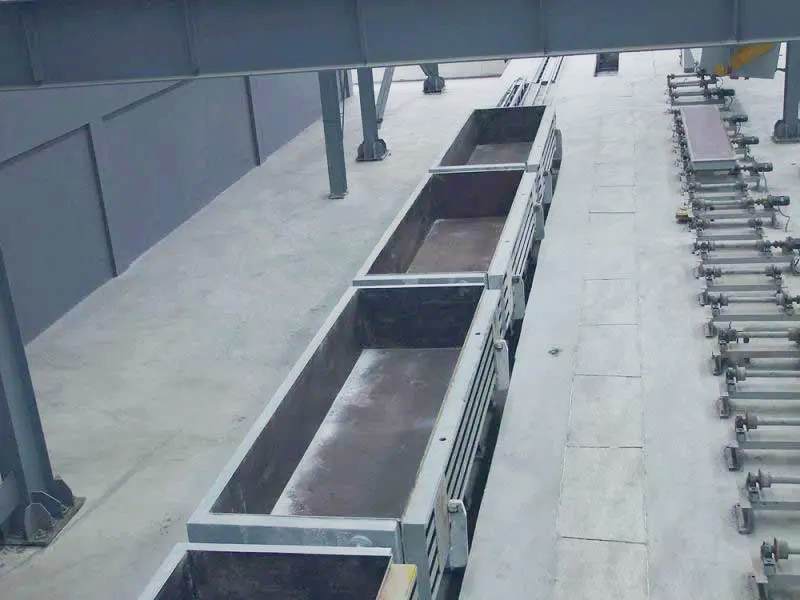
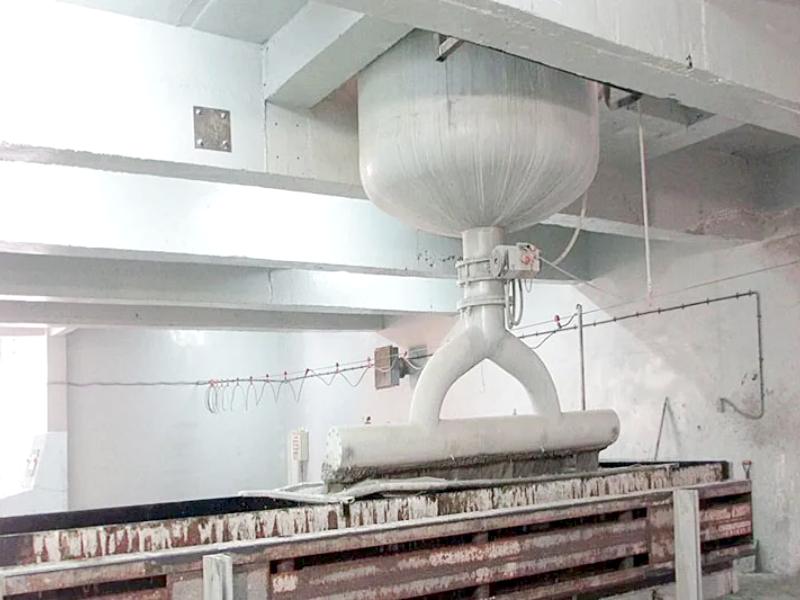
Schimmelpilze: Maßgefertigt aus hochfestem Stahl mit spezieller Oberflächenbehandlung, in der Größe anpassbar an die verschiedenen Produktspezifikationen.
Gießereimaschinen: Die Einspritzmenge der Gülle wird präzise gesteuert, und einige sind mit einer automatischen Bewegung ausgestattet, um Materialmangel oder Überlauf zu vermeiden.
Härtekammer: Eine konstante Temperatur- und Feuchtigkeitsumgebung sorgt für die Belüftung des Schlamms und seine anfängliche Aushärtung, was zu einer gleichmäßigen porösen Struktur führt.
4. Schneidausrüstung
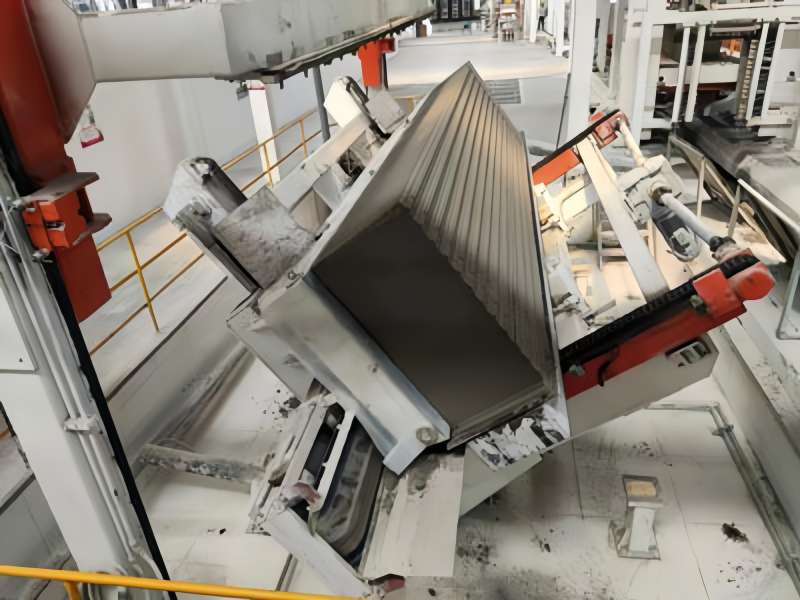
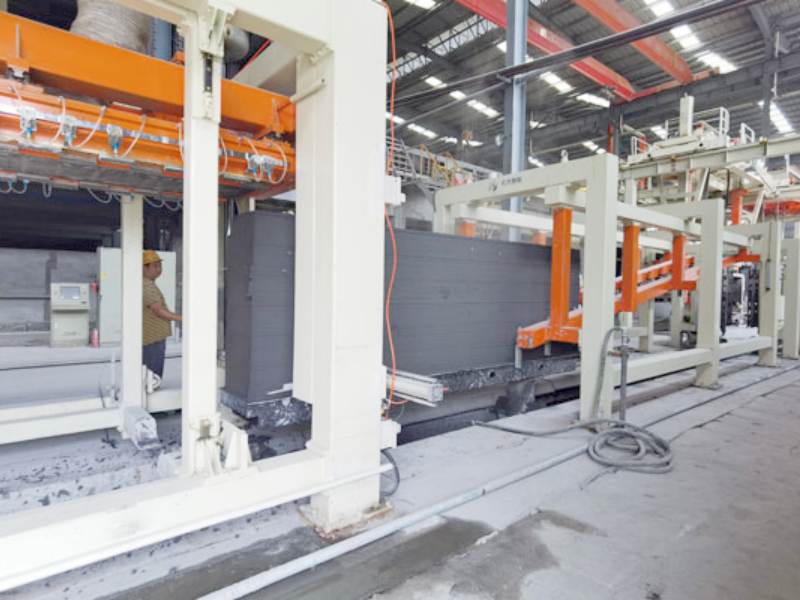
Drehtisch: Der hydraulische Antrieb sorgt für eine gleichmäßige Drehung der Formen und Rohlinge, was das Entformen und Schneiden erleichtert.
Drahtsäge: Verwendet mehrere Sätze hochfester Stahldrähte für Hochgeschwindigkeitsschnitte. Ein CNC-System sorgt für millimetergenaues Schneiden. Bei großen Drahtsägeanlagen ist ein kontinuierlicher Schnitt an mehreren Stationen möglich.
5. Autoklaven-Härtungsgeräte
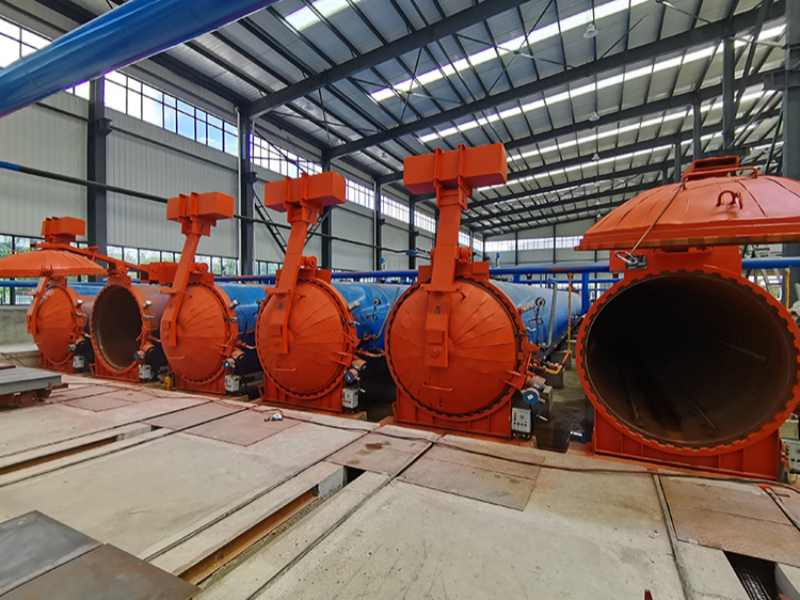

Autoklaven: Große Druckbehälter härten Rohlinge bei Temperaturen von 180-200°C und Drücken von 10-12 bar aus und bilden hochfeste Kalziumsilikathydrate. Ausgestattet mit Sicherheitsverriegelungen.
6. Hilfsmittel

Dampfkessel: Lieferung von stabilem Dampf für Autoklaven und Aushärtekammern, mit verschiedenen Beheizungsoptionen verfügbar.
Luftkompressor: Liefert Druckluft für pneumatische Geräte und stellt sicher, dass Ventile, Klemmen und andere Geräte ordnungsgemäß funktionieren.
Förderbandsystem: Transportiert Materialien durch den gesamten Prozess. Verwendet Band- oder Kettenförderer (je nach Materialbedarf) für eine automatisierte, kontinuierliche Bewegung.
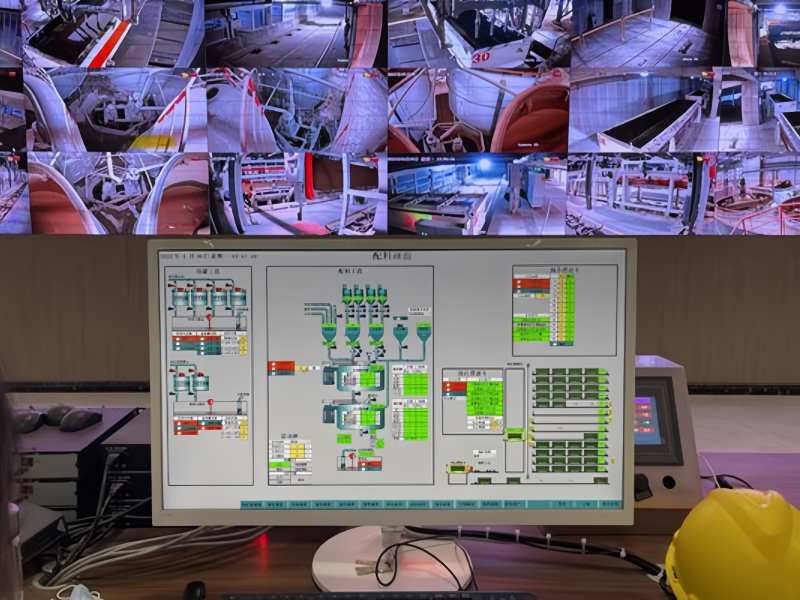
Kontrollsystem: PLC- oder DCS-Systeme überwachen und regulieren Produktionsparameter in Echtzeit. Sie zeichnen Daten für die Verwaltung und Rückverfolgbarkeit auf und helfen, Probleme umgehend zu beheben.
Automation Impact on Production Stability
Automation is not only about reducing labor—it is about stabilizing output quality.
| Automatisierungsgrad | Output Stability | Operator Dependency | Risk Level |
|---|---|---|---|
| Manual | Low | High | High |
| Semi-auto | Mittel | Mittel | Mittel |
| Vollautomatisch | High | Low | Low |
In AAC production, instability usually comes from human variation, not equipment failure. That is why most modern plants move toward higher automation levels.
Production Cost & Efficiency Optimization
Cost in AAC production is not fixed—it depends heavily on process efficiency.
Typical cost structure:
| Cost Factor | Impact Level |
|---|---|
| Raw material | High |
| Steam energy | High |
| Labor | Mittel |
| Wartung | Mittel |
| Waste rate | Very High |
The biggest hidden cost is waste rate from cutting and curing imbalance.
ROI reference (typical 150,000 m³ plant)
| Artikel | Value |
|---|---|
| Investment | ~$4–5M |
| Jährlicher Output | 150,000 m³ |
| Net Profit per m³ | $8–12 |
| Amortisationszeit | 2–3 years |
Efficiency improvement of even 3–5% can significantly change annual profit.
Common Production Problems & Solutions
From real project experience, most operational issues fall into four categories:
- Block cracking after autoclave
- Inconsistent density
- Cutting deviation
- Uneven curing strength
| Problem | Root Cause | Solution |
|---|---|---|
| Cracking | Steam imbalance | Adjust autoclave cycle |
| Density variation | Mixing inconsistency | Improve dosing system |
| Size deviation | Cutting misalignment | Upgrade wire system |
| Weak strength | Raw material fluctuation | Stabilize slurry system |
Most problems are not “equipment failure”—they are system imbalance issues.
Our Case Study
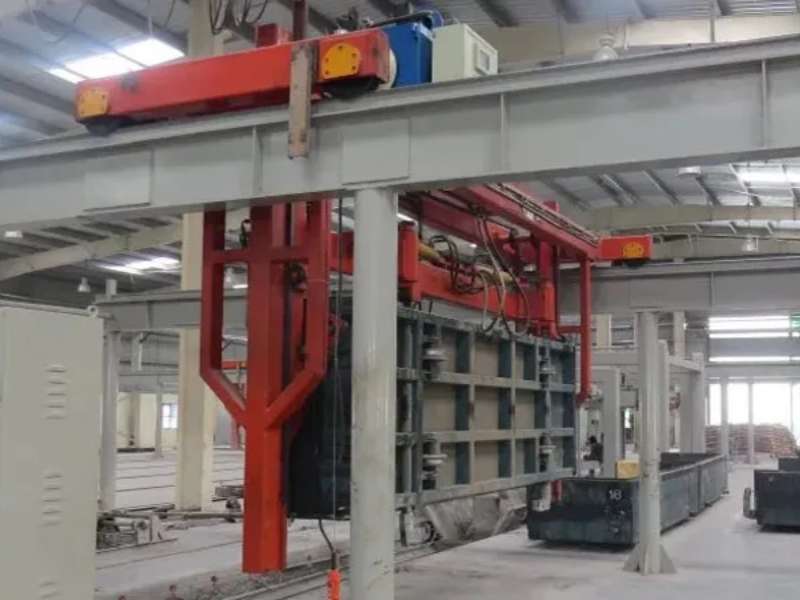
In this project, the client initially focused on equipment purchase rather than process balance.
After commissioning, they faced:
- Uneven production rhythm
- Cutting delays
- Autoclave underutilization
We re-evaluated the entire process flow and adjusted:
- Cutting cycle synchronization
- Material feeding timing
- Autoclave scheduling
After optimization, production stabilized and reached designed capacity.

This project had a different challenge: environmental conditions.
High temperature and humidity affected:
- Slurry stability
- Pre-curing timing
- Material handling consistency
We adjusted:
- Mixing water ratio control
- Pre-curing chamber insulation
- Conveyor speed synchronization
Result:
- Stable production under local climate conditions
- Reduced material waste rate
- Improved daily output consistency
FAQs
Q1: What is the most important part of AAC production?
The cutting system and autoclave system have the highest impact on final quality.
Q2: Can AAC production be fully automated?
Yes, modern plants can reach full automation, but system balance is still essential.
Q3: Why do some plants fail to reach designed capacity?
Usually due to process imbalance, not equipment quality.
Q4: How long does it take to stabilize production?
Typically 1–3 months after commissioning, depending on operator experience.
Q5: Can production be optimized after installation?
Yes, most improvements come from process tuning rather than equipment replacement.




Optimize Your Production Line with Our Engineers
If you are planning an AAC project or facing production instability, the key is not buying new machines—it is understanding how your current system is performing.
When we work with clients, we usually start from:
- Raw material analysis
- Production flow review
- Bottleneck identification
- Capacity matching
Based on this, we can help you define:
- System optimization plan
- Equipment upgrade suggestions
- Efficiency improvement strategy
This approach is usually more effective than replacing individual machines.