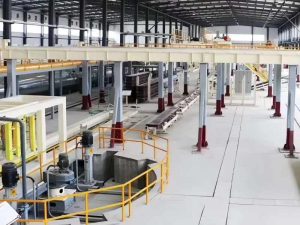
20,000 m³/year AAC Block Manufacturing Plant Delivered to Uganda
In 2025, we supplied and commissioned a 20,000 m³/year autoclaved aerated concrete (AAC) block manufacturing plant for a building materials company in Uganda. The solution was tailored to support local production of AAC blocks serving residential, commercial, and infrastructure construction projects across Kampala and surrounding regions. The plant configuration was designed for reliable operation with local raw materials and workforce, enabling consistent product quality and efficient production.
| Country | Uganda |
|---|---|
| Location | Kampala Industrial Area |
| Annual Capacity | 20,000 m³ |
| Plant Type | Semi‑automatic AAC block manufacturing unit |
| Productos principales | AAC blocks |
| Materias primas | Cement, lime, sand/fly ash, gypsum |
| Service Scope | Design, equipment supply, delivery, installation & training |

Construction Materials Demand in Uganda
Uganda’s construction industry continues to grow, driven by urban development in Kampala, Jinja, Gulu, and other regional centres. Builders and contractors demand faster, more efficient materials that reduce labour and overall building costs. Traditional clay bricks and solid blocks remain common, but their weight and slower construction speeds are pushing industry players to adopt lightweight alternatives that offer better thermal performance and easier handling.
Local industries also support accessible base materials such as cement and aggregates, with suppliers like Tororo Cement and Kampala Cement Company providing key inputs for masonry production in the region. This availability makes on‑site AAC block production more viable for local companies looking to diversify and expand beyond traditional materials.
Client Profile and Investment Purpose
The client in this project is a Ugandan distributor of building materials seeking to expand into AAC block manufacturing to improve supply reliability and capture new market opportunities. Prior to this investment, regional contractors often sourced AAC blocks through import or nearby suppliers, leading to longer lead times and higher costs. The client aimed to establish local production capacity that aligns with market requirements and allows flexibility in daily output according to project needs.
Key investment considerations included:
- Suitability of plant capacity for regional demand
- Integration of local raw materials into mix design
- Manageable land and operational footprint
- Balanced initial investment and operating cost
The selection of a 20,000 m³/year AAC block plant was based on market size and the client’s strategic plan to serve urban and peri‑urban construction segments efficiently. By starting with this capacity, the client can establish a stable production base and explore future scaling opportunities.
Tailored AAC Block Production Workflow
The AAC block manufacturing plant supplied to Uganda was configured to suit local conditions and production goals. It integrates the full process from raw material preparation to finished product handling.
Main Production Steps
Raw Material Storage & Batching
Cement, lime, sand or fly ash and gypsum are stored and fed into accurate weighing systems to ensure consistent mix proportions.
Slurry Mixing
Materials are blended into a homogeneous slurry using high‑efficiency mixers, with precise aluminium dosing to create the aerated structure.
Casting & Pre‑Curing
The aerated slurry is cast into moulds and allowed to pre‑cure, forming semi‑solid blocks known as “green cakes.”
Demoulding & Cutting
Green cakes are demoulded and cut into specified block sizes with controlled dimensional accuracy.
Autoclave Curing
Blocks are loaded into autoclaves for steam curing under controlled temperature and pressure, developing final strength and insulation properties.
Block Handling & Packaging
Finished blocks are separated, stacked, and prepared for storage or delivery to local construction sites.
This workflow ensures the production of AAC blocks with consistent quality and performance across batches. The semi‑automatic design simplifies operation while maintaining flexibility for varied output.
Equipment Included in the Plant
The plant consists of a complete set of machinery necessary for AAC block production:
- Raw material batching and weighing systems
- High‑efficiency slurry mixers
- Moulds and casting tables
- Cutting machines for precise sizing
- Autoclave chambers and steam generation system
- Material handling trolleys and stacking equipment
Each component was configured to operate efficiently under local power standards and adapted to Uganda’s industrial environment, with considerations for ease of maintenance and long‑term reliability.
Installation Support and On‑Site Training
The project was delivered on a turnkey basis, including detailed installation and training services:
- Plant Installation: Guided assembly and connection of all equipment according to the approved layout.
- Commissioning & Adjustment: Trial runs and adjustments to ensure the plant reaches designed capacity and output quality.
- Operator Training: Practical training for local workers on equipment operation, safety procedures, routine maintenance and quality control.
The training focused on building the client’s in‑house capability to operate the plant independently and handle common production scenarios.
Operational Results and Benefits
Following commissioning, the 20,000 m³/year Planta de fabricación de bloques de hormigón celular achieved stable daily output and product reliability. The client has benefited from:
- Consistent local supply of AAC blocks for varied construction needs
- Shorter delivery times compared with externally sourced blocks
- Enhanced control of product quality and production scheduling
- Improved cost management through local material utilisation
The produced AAC blocks are now used in residential developments, commercial buildings and infrastructure projects across the region.
Typical Uses of AAC Blocks Produced
AAC blocks from this plant are suitable for:
- Load‑bearing and non‑load‑bearing walls
- Partition walls and infills
- Residential housing construction
- Commercial and institutional buildings
Their lightweight nature and good insulation properties support faster build times and contribute to improved thermal comfort.

¿Por qué elegirnos?

- Tailored Plant Design – Each AAC plant is configured for local conditions and raw materials.
- Balanced Capacity – 20,000 m³/year units provide stable supply with manageable investment.
- Turnkey Delivery – From layout planning to installation and operator training, the project is coordinated end-to-end.
- Durable Equipment – Reliable, easy-to-maintain machinery built for long-term operation.
- On-Site Support – Hands-on training ensures local teams can run the plant independently.
Ready to Launch Your AAC Block Manufacturing Plant?
Our 20,000 m³/year AAC block manufacturing plant offers a practical solution for building material suppliers, contractors, and entrepreneurs seeking to establish local AAC production. The plant is designed for stable operation with straightforward maintenance and scalable options to grow with your business.
Contact us today to get a tailored feasibility study and detailed quotation for your plant project.