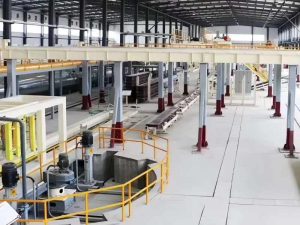
To strengthen competitiveness and unlock higher-value building material opportunities, a Nigerian client chose to invest in a 20,000 m³/year AAC block manufacturing plant—a compact, practical solution that enables stable production while keeping investment and operating requirements within reach.
Project Overview
This project is a 20,000 M3/Year AAC Block Manufacturing Plant in Nigeria, designed for local market supply with reliable daily output, flexible operation, and consistent block quality. The plant helps the customer upgrade from conventional blocks into AAC lightweight blocks, supporting contractors who need faster installation and improved thermal performance.
Project Location: Nigeria
Annual Capacity: 20,000 m³/year
Product Type: AAC Blocks (Autoclaved Aerated Concrete Blocks)
Production Line Type: Small AAC Block Manufacturing Plant
Application Markets: Residential housing, commercial partitions, infill walls, public facilities, industrial buildings

Why the Client in Nigeria Invested in an AAC Block Manufacturing Plant?
Nigeria’s building materials market has clear demand for solutions that reduce total construction cost—especially when labor efficiency, logistics, and energy performance are considered.
The client’s key drivers included:
Strong Demand for Affordable Housing
Across many Nigerian cities, developers and contractors are under pressure to deliver housing faster and at controlled budgets. AAC blocks help speed up wall construction with easier handling and fewer blocks per square meter.
Rising Labor Cost & Need for Faster Construction Cycles
Compared with dense blocks, AAC blocks are lighter and easier to install—helping reduce labor intensity and improve productivity on site.
Growing Preference for Lightweight & Thermal Insulation Materials
In many regions of Nigeria, heat control and indoor comfort matter more than ever. AAC blocks provide better thermal insulation than traditional dense blocks, improving building energy efficiency.
Logistics Optimization for Distribution
Transporting heavy blocks is costly and inefficient over longer distances. Lightweight AAC blocks reduce transport burden and can improve delivery economics to nearby cities and developing areas.
Why 20,000 m³/Year is a Smart Small AAC Block Production Line Option?
For many first-time AAC investors, the biggest concerns are typically: investment safety, operation complexity, market acceptance, and ROI timeline. That is why this client selected a 20,000 m³/year small AAC block production line.
This capacity is ideal for:
- New AAC manufacturers entering the market
- Traditional block factories upgrading product range
- Investors targeting regional supply instead of nationwide distribution
- Projects requiring controlled CAPEX with scalable planning
Key Advantages of a Small AAC Block Manufacturing Plant
- Lower initial investment vs large AAC plants
- Smaller footprint & easier factory layout planning
- Simpler staffing and maintenance requirements
- Stable market testing with manageable production output
- Scalable upgrade potential for future expansion
AAC Block Products Produced in This Nigeria Plant
This AAC plant is configured for stable production of:
- Standard AAC blocks for load-bearing / non-load-bearing walls
- AAC blocks for partition walls in apartments and offices
- Lightweight blocks for fast housing projects
- Thermal insulation wall blocks for hot climate regions
AAC block sizes can be customized based on local market demand and common construction standards.
Production Process of the AAC Block Manufacturing Plant
To ensure consistent strength and density, the AAC blocks are produced using a standardized industrial workflow.
AAC Production Steps
- Preparación de la materia prima (cement, lime, gypsum, silica material, aluminum powder)
- Batching & mixing with automatic dosing control
- Casting into molds
- Precurado to reach cutting strength
- Cutting system for accurate block dimensions
- Autoclave for high-strength curing
- Finished product packaging and delivery
This workflow supports reliable mass production while maintaining high product consistency—critical for building contractors and long-term client repeat purchases.
Key Configuration Highlights
Nigeria-based AAC investors often prioritize equipment reliability, stable supply chain planning, and efficient plant operation. This production line was designed around those needs.
Reliable Automation for Stable Output
The line integrates essential automation to reduce dependency on operator experience and maintain repeatable product quality.
Efficient Material Handling & Factory Workflow
A compact line layout improves movement efficiency across batching, casting, cutting, and autoclaving—supporting daily production stability.
Energy & Utility Considerations
For Nigeria’s industrial environment, the plant design focuses on utility matching, operational continuity planning, and cost control—especially important for small and medium-sized factories.
Installation & Commissioning Support
To ensure the client can start production smoothly, the project includes:
- Factory layout guidance and process planning
- Equipment installation supervision
- Commissioning and test production support
- Operator training for daily production management
- Quality control guidance (density, strength, cutting accuracy)
This support model helps reduce start-up risks and improves early-stage efficiency, especially for customers transitioning from traditional block production.
What Nigerian Customers Care About Before Buying an AAC Block Plant
Based on market feedback, buyers searching for 20,000 M3/Year AAC Block Manufacturing Plant in Nigeria typically focus on the following:
AAC Block Plant Cost & Investment Return
Clients want a line that can enter production quickly and generate stable revenue. A small AAC line is often chosen for lower entry risk and faster payback planning.
Daily Output & Market Demand Matching
20,000 m³/year capacity is well-suited for regional distribution—helping avoid inventory pressure while still meeting contractor needs.
Block Quality Consistency
Contractors need stable product performance. Consistent cutting accuracy and autoclaved curing quality improve customer trust and repeat orders.
Factory Space & Layout
Smaller AAC plants are easier to deploy and can fit industrial areas with limited land availability compared with large-scale plants.
Operation & Maintenance Requirements
Small AAC production lines are typically easier to manage, with more controllable staffing and maintenance needs.
Comentarios de los clientes
After installation and production stabilization, the client shared practical feedback from operations and market response:
Client Review:
“We needed a solution that could help us shift from traditional blocks to a higher-value product without overspending on a very large line. The 20,000 m³/year AAC plant fits our plan perfectly. The production is stable, block size is accurate, and contractors are satisfied with the lighter weight and faster wall building speed.”
Why AAC Blocks Are Increasingly Competitive in Nigeria?
AAC blocks provide advantages that align strongly with Nigeria’s construction trends:
- Faster wall construction and improved job-site efficiency
- Reduced structural dead load due to lightweight properties
- Better thermal insulation for hot climate applications
- Cleaner wall finishing and improved project appearance
- Strong market acceptance in modern residential and commercial builds
For investors seeking a new profit path in building materials, AAC is becoming a high-potential category.

Looking for a 20,000 m³/Year AAC Block Plant?
If you are planning to build or invest in a small AAC block manufacturing plant, a 20,000 m³/year AAC block production line is an excellent starting point—balancing capacity, investment, and market flexibility.
We provide complete solutions including:
- Plant layout design and engineering support
- AAC block production line equipment supply
- Installation & commissioning guidance
- Operator training and production support
- Expansion planning for future capacity upgrades
Request a full proposal now:
Get the recommended configuration, layout plan, and quotation for your AAC block project.