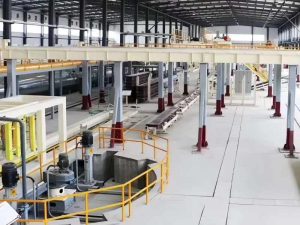
In 2025, we successfully delivered and commissioned a 20,000 m3 AAC block manufacturing plant to Indonesia, with capacity of 20,000 Cubic Meters per year. This plant empowering our client to scale AAC block production to meet the surging demand in Southeast Asia’s largest construction market. Indonesia’s rapid urbanization, strong infrastructure initiatives, and growing interest in energy-efficient building materials have accelerated adoption of AAC blocks as an alternative to traditional clay bricks and concrete blocks.
Project Overview — Turnkey AAC Block Plant in Indonesia
Country: Indonesia
Annual Production Capacity: 20,000 m³ AAC blocks
Plant Type: Small to Medium-scale AAC Block Manufacturing Plant
Project Owner: Indonesian building materials supplier
Supporting Services: Custom plant design, equipment supply, logistics coordination, on-site installation, commissioning, operator training, and after-sales support
The project scope included tailored engineering and installation to align with Indonesia’s raw material characteristics and construction standards — ensuring efficient operation and consistent product quality.

What Is a 20,000 m³ AAC Block Manufacturing Plant?
An Autoclaved Aerated Concrete (AAC) block plant is a specialized manufacturing line that produces lightweight, porous building blocks using an automated process. AAC blocks offer advantages over clay bricks and ordinary concrete blocks, particularly in terms of thermal insulation, weight reduction, dimensional precision, and construction speed. A 20,000 m³/year capacity plant suits businesses entering AAC production or expanding into energy-efficient building materials without the large footprint and cost of bigger facilities.
Why Indonesia Needs a 20,000 m³ AAC Block Manufacturing Plant?
1. Explosive Growth in Indonesia’s Construction Sector
Indonesia has one of Southeast Asia’s most vibrant construction markets. Urbanization, infrastructure investment, affordable housing initiatives, and commercial real estate growth are driving demand for modern construction materials. Government programs such as the National Medium-Term Development Plan (RPJMN) emphasize infrastructure and housing, creating sustained demand for masonry products. AAC blocks are increasingly specified in large residential complexes, office buildings, schools, and public facilities — contributing to Indonesia’s rapid infrastructure build-out.
2. Strong Market Demand for Energy-Efficient and Lightweight Blocks
Traditional clay bricks and heavy concrete masonry units remain widely used in Indonesia, but challenges persist:
- High transportation and labour costs
- Longer construction schedules
- Poor insulation in a tropical climate
AAC blocks resolve these problems by delivering:
- Superior thermal insulation, reducing cooling loads in hot, humid environments
- Lighter weight, cutting structural load and transport costs
- Uniform block size, boosting installation speed and reducing mortar use
- Fire resistance and sound insulation, enhancing building performance
These benefits translate into tangible savings and performance improvements that appeal to developers, contractors, and end users across Indonesia.
3. Reducing Dependency on Imported Blocks
Many Indonesian builders still rely on imported block materials or regional suppliers from neighboring countries. This increases lead time, cost, and supply risk. A local 20,000 m³ AAC block plant allows manufacturers to offer competitive pricing, faster delivery, and higher inventory control — strengthening market position and customer confidence.
4. Alignment with Sustainable Building Trends
Global and local stakeholders in Indonesia are increasingly valuing sustainable construction. AAC blocks require less energy to install, offer better energy performance, and improve the overall efficiency of buildings, aligning with green building certifications and sustainable development goals.
Production Workflow & Technical Highlights
The 20,000 m³/year AAC block plant delivered to Indonesia features an optimized production line designed for efficiency, reliability, and consistent product quality:
- Raw Material Batching: Automated batch weighing for cement, sand/fly ash, lime, gypsum, and water ensures consistent slurry composition.
- Mixing: High-efficiency mixers blend raw materials into a uniform slurry with precise aeration control.
- Pouring & Pre-Curing: Slurry is poured into molds, allowing uniform pre-curing into “green cakes.”
- Taglio: CNC cutting machines produce dimensionally accurate blocks per custom size requirements.
- Autoclave: High-pressure steam curing finalizes the blocks with desired strength, density, and insulation properties.
This standardized workflow supports steady output, low breakage rates, and high dimension accuracy — essential for market acceptance and brand reputation in the Indonesian construction ecosystem.
Raw Material Availability & Plant Design for Indonesia
Indonesia has abundant access to key raw materials needed for AAC block production:
- Cement & Fly Ash: Available from local cement plants and coal-fired power generation by-products
- Sand & Aggregates: Readily sourced from local quarries
- Lime & Gypsum: Accessible via domestic and regional chemical suppliers
The plant layout was custom-designed to maximize land utilization while enabling smooth raw material handling and production flow — critical in Indonesian industrial zones where space and utilities differ from Western plants.
Installation, Commissioning & Operator Training
Our team provided full project support:
- Pre-installation consultation to optimize layout and utility integration
- Equipment manufacturing quality tests before shipment to Indonesia
- Logistics coordination and customs support for smooth import procedures
- On-site installation and commissioning supervision by experienced engineers
- Operator and maintenance training delivered in Bahasa Indonesia and English
- After-sales support and spare parts supply to ensure long-term efficiency
This turnkey service enabled the client to achieve stable production quickly with minimal downtime.
Applications of AAC Blocks in Indonesian Construction
Blocks produced by this plant are widely used for:
- Residential housing – walls and partitions
- Commercial complexes and offices
- Industrial buildings and warehouses
- Public infrastructure – schools, hospitals, government buildings
- Tourism & hospitality developments – resorts and hotels
This flexibility underscores AAC blocks as a versatile, profitable building material for diverse construction segments in Indonesia.
Client Results & Market Impact
Since the AAC block plant was commissioned in Indonesia:
- The client achieved steady weekly production reaching design capacity
- AAC blocks gained strong acceptance among local builders and contractors
- Construction projects reported faster build times and better thermal comfort
- The company expanded market reach across Java and Sumatra, capturing a larger share of the local masonry market
This case demonstrates how a 20,000 m³ AAC block plant can deliver real business value in Indonesia’s competitive construction landscape.

Why Choose Our AAC Block Plant Solution for Indonesia?

- Turnkey Services: From feasibility assessment to long-term operational support
- Localized Engineering: Plant design adapted to Indonesia’s raw materials and utility conditions
- Stable Production & Quality: Consistent output and less waste
- Operator Training & After-Sales Support: Ensuring efficient operation and fast troubleshooting
- Growth-Oriented Capacity: Ideal for both initial entry and subsequent expansion in the Indonesian market
Whether launching your first AAC plant or scaling your current operations, this solution delivers reliable performance and strong return on investment.
Start Your AAC Block Manufacturing Project Today
Are you planning a 20,000 m³/year Impianto di produzione di blocchi AAC for your country?
Contact us now for a free feasibility study, customized plant layout, and professional quotation tailored to your budget, location, and market goals.