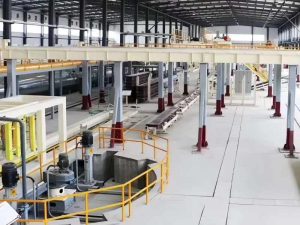
South Africa’s construction sector is moving toward faster project delivery, better energy performance, and more efficient building methods. As demand grows for affordable housing, commercial developments, and upgraded infrastructure, builders and material suppliers are increasingly adopting lightweight wall solutions that help reduce structural load and improve jobsite productivity.
To meet these requirements and expand its product portfolio, a South African client invested in a 20,000 m³/year AAC block plant—a compact production line designed for reliable output, consistent quality, and practical day-to-day operation.
Project Overview
This project is a 20,000 m³/year AAC block manufacturing plant delivered to South Africa, supporting the client’s transition from conventional masonry products to high-value autoclaved aerated concrete solutions.
Project Country: South Africa
Annual Capacity: 20,000 m³/year
Product: AAC Blocks (Autoclaved Aerated Concrete Blocks)
Plant Type: Small AAC Block Production Line
Applications: Residential housing, commercial buildings, partition walls, infill walls, public facilities
With this plant, the client is now positioned to supply lightweight blocks that support faster construction cycles while improving overall wall performance.

Why the Client Chose AAC Block Production in South Africa?
The client evaluated several building material options before confirming AAC as the most promising direction for long-term market growth. Key factors included:
Strong Demand for Faster Construction Cycles
Time-to-completion has become a major driver in South Africa’s housing and commercial project planning. AAC blocks are lightweight and easy to handle, allowing teams to build walls more quickly and with less physical strain.
Increasing Focus on Energy Efficiency and Comfort
AAC blocks offer strong thermal insulation performance, helping buildings maintain more stable indoor temperatures. This contributes to better comfort and energy efficiency, especially in areas with significant temperature variation between day and night.
Lightweight Wall Materials for Modern Structures
Because AAC blocks are significantly lighter than many traditional masonry products, they help reduce the dead load of the structure. This is particularly valuable for multi-storey buildings, renovations, and projects that require efficient structural design.
Product Upgrade and Market Differentiation
The client wanted to move beyond low-margin conventional block products. AAC blocks provided a higher-value segment with strong demand from contractors seeking advanced building materials.
20,000 m³/Year Capacity: A Practical Small AAC Block Plant
A 20,000 m³/year AAC block manufacturing plant is widely recognized as a small AAC production line, ideal for investors who want stable production without the pressure of operating a large-scale factory.
Advantages of a Small AAC Block Manufacturing Plant
- Lower investment scale compared with high-capacity lines
- Easier factory planning and workflow organization
- Manageable staffing requirements for daily operation
- Faster commissioning and smoother production ramp-up
- Better alignment with regional supply and controlled inventory management
- Flexible expansion planning for future growth
For many customers, this capacity is an ideal starting point to build market presence and gradually increase output as demand grows.
AAC Block Products for South Africa Construction Applications
This AAC plant is designed to produce a stable range of AAC blocks suitable for both residential and commercial construction.
Common applications include:
- Exterior and interior walls for housing projects
- Partition walls for apartments and office buildings
- Infill walls for frame structures
- Public facilities and community developments
- Renovation and extension projects
AAC blocks are valued for their lightweight handling, consistent dimensions, and easy finishing performance.
AAC Block Production Process
To ensure consistent strength, density, and cutting accuracy, the plant uses a proven industrial production workflow:
- Preparazione delle materie prime (cement, lime, gypsum, silica material)
- Automatic batching and precise weighing
- High-efficiency mixing system
- Mold pouring and casting
- Pre-indurente to reach cutting strength
- Precision cutting for accurate block dimensions
- Polimerizzazione in autoclave for performance stability
- Finished product stacking and dispatch
This process ensures that the AAC blocks maintain reliable performance for real construction environments and contractor requirements.
Key Equipment Configuration of the Production Line
To support stable output and consistent product quality, the production line includes core equipment systems such as:
- Raw material handling and conveying
- Automatic dosing and batching system
- Mixing and casting section
- Mold circulation system
- Cutting machine for AAC green cake
- Autoclave curing system
- Finished product handling and stacking
The configuration is optimized for long-term operation, with practical maintenance planning and efficient workflow design.
Plant Design Considerations for Local Operating Conditions
Successful AAC production is not only about equipment—it also depends on how well the solution matches real operating needs.
This project was designed to support:
- Efficient internal logistics and smooth material flow
- Practical operation for small-to-medium production teams
- Stable production rhythm and manageable maintenance schedules
- Consistent product output quality for long-term customer retention
The compact layout helps the client run production effectively while keeping daily management clear and controllable.
Installation, Commissioning, and Training Support
To ensure the client could enter production smoothly, the project included complete technical support such as:
- Factory layout planning guidance
- Equipment installation supervision
- Commissioning and trial production support
- Operator training for process control and production management
- Quality control guidance to maintain stable block performance
This support helped shorten the learning curve and improve the stability of early-stage production.
What Matters Most When Building an AAC Block Plant in South Africa
For many investors and manufacturers, practical decision-making often comes down to the following:
Investment Control and Operating Stability
A small AAC plant helps balance investment planning with stable manufacturing capability.
Capacity Planning and Local Distribution
20,000 m³/year offers a strong balance between output and regional market supply, supporting steady sales growth without excessive inventory pressure.
Factory Space and Layout Efficiency
A compact plant can be planned more easily and adapted to a wider range of industrial land conditions.
Product Consistency for Contractor Confidence
Uniform sizing, smooth cutting surfaces, and stable curing quality help earn contractor trust and repeat purchases.
Service and Technical Support
Long-term technical assistance and production guidance are key to stable factory operation and future expansion.
Feedback dei clienti
After production launch and stable operation, the client shared the following experience:
“We wanted a compact AAC production line that could be managed efficiently while delivering reliable block quality. The 20,000 m³/year plant fits our plan well. The blocks are consistent in size, production runs smoothly, and the market response has been very positive—especially from contractors who value lightweight materials and faster wall construction.”
Why AAC Blocks Are a Strong Fit for the South Africa Market?
AAC blocks align well with modern construction priorities:
- Lightweight blocks for easier handling and improved jobsite efficiency
- Better thermal insulation for improved indoor comfort
- Reduced dead load and more flexible structural solutions
- Smooth surfaces for easier finishing work
- Strong value for housing, commercial, and public facility projects
For manufacturers, AAC blocks offer a long-term growth opportunity with a more differentiated product line.

Ready to Start a 20,000 m³/Year AAC Block Plant?
If you are planning to build or invest in a small AAC block manufacturing plant, a 20,000 m³/year AAC block production line is an excellent starting point—balancing capacity, investment, and market flexibility.
We provide complete solutions including:
- Plant layout design and engineering support
- AAC block production line equipment supply
- Installation & commissioning guidance
- Operator training and production support
- Expansion planning for future capacity upgrades
Request a full proposal now:
Get the recommended configuration, layout plan, and quotation for your AAC block project.