
As a professional manufacturer of AAC block production equipment, we have supplied and commissioned a 100000 m3 AAC block plant in Kenya, supporting the project from equipment manufacturing to on-site trial production. The plant has completed installation and trial operation, and is now positioned for stable commercial output.
Technical Overview of a 100000 m3 AAC Block Plant in Kenya
A 100000 m3 AAC block plant in Kenya represents a medium-to-large industrial configuration designed for continuous production rather than intermittent batching.
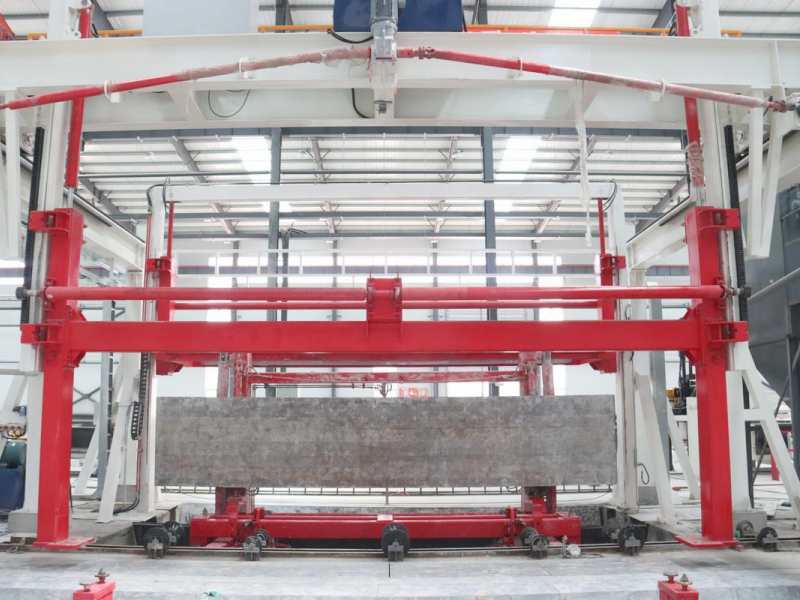
From a technical perspective, the production line includes:
- Raw material preparation and accurate dosing systems
- Slurry mixing and pouring units with stable density control
- Precision cutting systems to ensure dimensional consistency
- Autoclave curing systems for strength development
- Finished product handling and stacking equipment
At this capacity, production stability becomes more important than maximum speed. The plant configuration prioritizes consistent output and manageable daily operation, which is essential for long-term project viability.
Our Clients’ Background and Needs
The Kenyan client for this 100000 m3 AAC block plant comes from a construction-related investment background rather than a pure machinery or manufacturing background.
Their primary concerns were practical:
- Whether the equipment could run reliably with local labor
- How sensitive the process would be to raw material variations
- Whether the plant scale matched realistic market demand
This is common among AAC investors. Most are not AAC specialists at the start, so clear equipment logic, stable operation, and structured training are more valuable than complex automation features.
Is a 100000 m3 AAC Block Plant the Right Investment Scale for Nigeria?
Although this article focuses on Kenya, many investors compare capacity decisions across African markets.
A 100000 m3 AAC block plant is typically suitable when:
- The local market can absorb consistent monthly output
- Transportation costs make centralized supply inefficient
- The investor aims to serve multiple projects or regions
The same decision framework often applies in Kenya and Nigeria, where AAC adoption follows similar patterns driven by urban development and cost-sensitive construction.
Market Demand for AAC Blocks in Nigeria Construction Industry
Nigeria is frequently referenced as a benchmark market due to its earlier AAC adoption. Observing Nigeria helps Kenyan investors understand future demand trends.
Key demand drivers seen in both markets include:
- Rapid residential and commercial construction
- Growing acceptance of lightweight masonry materials
- Increased focus on construction efficiency and labor savings
For this reason, the capacity of a 100000 m3 AAC block plant in Kenya aligns well with projected medium-term demand growth.
Brief Introduction of Our 100000 m3 AAC Block Plant
Il 100000 m3 AAC block plant in Kenya supplied by us is designed as a balanced production system rather than an oversized industrial complex.
Key characteristics include:
- Equipment matched to locally available cement, lime, and sand
- Logical plant layout to reduce internal material handling
- Stable autoclave curing system optimized for energy efficiency
The entire line was configured with long-term operation in mind, avoiding unnecessary complexity that could increase maintenance risk.
Raw Materials Availability for AAC Block Production in Nigeria
While raw material discussions often reference Nigeria, the same evaluation method applies to Kenya.
AAC block production primarily relies on:
- Cement
- Lime or limestone
- Silica sand or alternative silica sources
- Polvere di alluminio
In Kenya, these materials are available through local or regional supply chains, which supports the sustainable operation of a 100000 m3 AAC block plant in Kenya without excessive dependence on imports.
Land, Power & Utility Requirements for AAC Block Plant in Nigeria
Infrastructure planning principles are similar across many African markets.
For a 100000 m3 AAC block plant, typical requirements include:
- Adequate industrial land for production and storage
- Reliable power supply or backup energy planning
- Stable water supply for mixing and curing processes
Early site planning plays a critical role in ensuring smooth installation and efficient daily operation.
Investment Cost & Return Expectation for 100000 m3 AAC Block Plant in Kenya
Investors evaluating a 100000 m3 AAC block plant in Kenya usually consider the total project scope rather than equipment cost alone.
Key investment components include:
- Production line equipment
- Civil works and foundation construction
- Installation, utilities, and commissioning
- Initial working capital
At this capacity level, unit production cost becomes more controllable, supporting reasonable return expectations once the plant reaches stable output.
Typical Applications of AAC Blocks Produced in Kenya
AAC blocks produced by a 100000 m3 AAC block plant in Kenya are widely used in:
- Residential housing developments
- Commercial and office buildings
- Educational and healthcare facilities
- Partition walls and infill structures
The reduced weight and easier handling of AAC blocks help contractors improve construction efficiency and reduce structural load.
Installation, Commissioning & Training for AAC Block Plant in Kenya
For the 100000 m3 AAC block plant in Kenya, we provided full on-site technical support throughout installation and trial operation.
Our scope included:
- On-site installation supervision by experienced engineers
- Step-by-step commissioning of each production section
- Operator and maintenance training based on real production scenarios
Training focused on daily operation control, material adjustment, and routine maintenance. Operators learned how to manage production variables in practice, not just how to start or stop equipment.
Expansion Possibilities: Can a 100000 m3 AAC Block Plant Be Upgraded Later?
One advantage of a 100000 m3 AAC block plant in Kenya is its scalability.
Future expansion options may include:
- Adding autoclaves to increase curing capacity
- Upgrading cutting systems for higher throughput
- Expanding packing and storage areas
The initial plant layout is designed to allow these upgrades without disrupting existing production.


Perché scegliere noi
As a manufacturer, our focus extends beyond equipment delivery.
Clients work with us because:
- We base plant design on real operating experience
- Equipment is adapted to local materials and conditions
- Technical support continues after commissioning
Our goal is to ensure that each 100000 m3 AAC block plant in Kenya operates steadily and predictably over the long term.
Interested in Building an AAC Block Plant?
A 100,000 m³ AAC block plant to South Africa is not just a manufacturing investment—it is a strategic entry into a robust market with real demand and long-term growth potential. Our solutions are engineered for performance, local integration, and profitable operations.
If you are evaluating AAC production opportunities, let us help you with feasibility analysis, investment planning, and complete implementation support tailored to your goals.




Frequently Asked Questions
Installation and commissioning typically take several months, depending on site readiness and utility availability.
Yes. With proper training and market planning, many first-time investors successfully operate at this scale.
Yes. After systematic training, local teams are fully capable of operating and maintaining a 100000 m3 AAC block plant in Kenya.