Why Do Buyers Look for a 32 m3/day AAC Block Manufacturing Plant?
Most buyers searching for a 32 m³/day AAC block manufacturing plant fall into one of the following categories:
- Investors exploring AAC technology for the first time
- Developers planning to supply AAC blocks for their own construction projects
- Small local producers serving isolated or low-demand areas
- Technical institutes or training centers requiring demonstration lines
- Buyers with very limited initial investment budgets
This capacity is usually not driven by large market demand, but by a desire to start small, test the process, or minimize upfront risk.

What Is the Actual Annual Output of a 32 m³/day AAC Plant?
Understanding real production capacity is critical before making any investment decision.
Under standard industry assumptions:
- Daily output: 32 m³
- Working days per year: 280–300 days
This results in an annual output of approximately 8,500–10,000 m³ of AAC blocks.
This figure reflects realistic operating conditions, including maintenance and downtime. Any claim significantly above this range should be carefully verified.
Who Is a 32 m³/day AAC Block Plant Really Suitable For?
A 32 m³/day AAC block manufacturing plant is best suited for:
- Pilot or trial AAC production
- Self-use AAC block supply for small construction projects
- Remote regions with very limited market demand
- Research, testing, or operator training purposes
However, it is not recommended for:
- Commercial AAC block sales in competitive markets
- City-level or regional material supply
- Investors seeking fast ROI through volume production
Setting the right expectations at this stage avoids costly mistakes later.
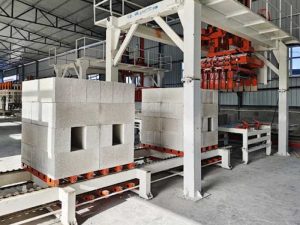
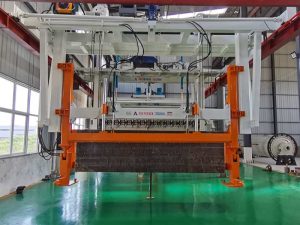
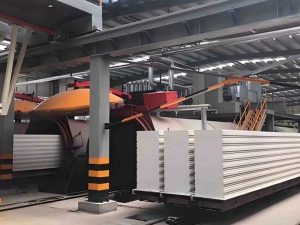
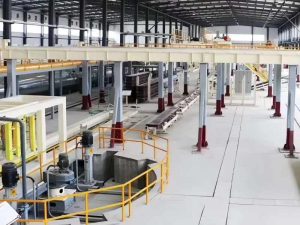
Production Line Configuration of a 32 m³/day AAC Block Plant
Despite its small capacity, a true AAC plant must still follow the complete AAC production process.
Vorbereitung des Rohmaterials
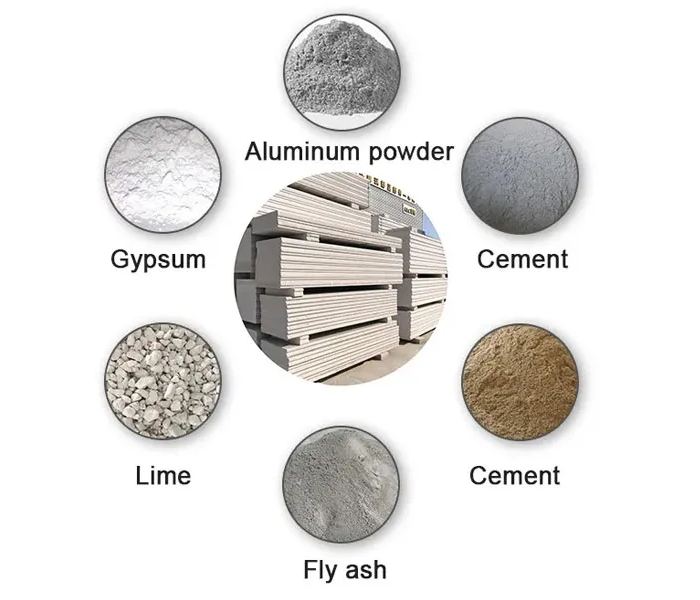
- Cement, lime, and gypsum feeding systems
- Simplified sand or fly ash preparation
- Basic batching accuracy suitable for small volumes
Mixing and Casting
- Slurry mixing unit with manual or semi-automatic operation
- Aluminum powder dosing adapted to small batch sizes
- Compact mold system
Pre-Curing and Cutting
- Basic pre-curing setup
- Simplified cutting frame
- Manual assistance during handling
Autoklavieren
- Small-sized autoclave
- Steam supplied by boiler or external source
- Limited curing batch size
While technically complete, this configuration prioritizes simplicity over efficiency.
Technical Limitations You Should Understand Before Investing
From a manufacturing and engineering perspective, small AAC plants come with inherent limitations:
- Higher cost per cubic meter due to lack of scale
- Labor-intensive operation
- Limited automation options
- Greater difficulty maintaining consistent quality
- Minimal buffer for production errors
These factors directly affect long-term operating stability and profitability.
Investment Cost vs. Operating Reality
A 32 m³/day AAC block plant does require a lower initial equipment investment, but this does not automatically mean lower overall cost.
Key realities include:
- Fixed costs spread over limited output
- Higher labor cost per unit
- Lower tolerance for raw material price fluctuation
- Limited ability to reduce production cost
For this reason, ROI expectations should be conservative and realistic.
Land Requirement and Infrastructure Needs
Even at small capacity, AAC production requires proper infrastructure:
- Estimated land area: 8,000–12,000 m²
- Reliable electricity and water supply
- Steam source for autoclaving
- Manual material handling and storage areas
Infrastructure quality directly impacts product consistency and safety.
When Should You Upgrade from 32 m³/day to a Larger AAC Plant?
In practice, many buyers outgrow this capacity faster than expected.
Common signals that an upgrade is necessary include:
- Demand exceeding daily production capacity
- Rising labor costs affecting unit price
- Difficulty competing with larger AAC suppliers
- Increasing quality consistency requirements
Typical upgrade paths move toward 50, 100, or 150 m³/day AAC block manufacturing plants, where efficiency and cost control improve significantly.
Turnkey Support and Customization Options
For small-capacity AAC projects, professional support is even more important.
A responsible AAC plant supplier should offer:
- Honest capacity evaluation before quotation
- Customized configurations based on project purpose
- Installation guidance and operator training
- Technical support during trial production
This approach minimizes operational risk and protects your investment.
Andere Hot-sale Block Manufacturing Plant
| Jährliche Produktion | Preis (USD) | Kern-Konfiguration |
|---|---|---|
| 100,000 m³ | 1.5-1.9 M | Schneiden im Luftstrom, 3×31 m Autoklaven |
| 150,000 m³ | 2.1-2.6 M | Palettierroboter, 4×31 m Autoklaven |
| 200,000 m³ | 2.8-3.5 M | Sechsseitiges Schneiden, 4×37 m Autoklaven |
| 300,000 m³ | 4.0-4.8 M | Zwei Schneidlinien, 6×37 m große Autoklaven |
| 400,000 m³ | 5.5-6.5 M | Vollautomatische Autoklaven mit Luftumwälzung, 8×37 m und mehr |
Make the Right Capacity Decision Before You Invest
A 32 m³/day AAC-Block-Herstellungsanlage can be a valid solution for trial production, self-use projects, or limited-demand applications. It is not designed for mass production or aggressive market competition.
If your goal is long-term commercial success, choosing the right capacity from the beginning is far more important than choosing the lowest initial price.
Kontakt today to discuss your project objectives, market conditions, and budget. Our technical team will help you determine whether a 32 m³/day AAC plant is suitable—or whether a higher-capacity solution will better support your business growth.