
What Is AAC Block Manufacturing Machinery?
AAC manufacturing machinery refers to the complete production system used to convert raw materials into finished AAC blocks, including preparation, mixing, forming, cutting, and autoclaving.
It is not a single line item. It is a process chain.
If one section is under-designed, the whole plant performance will be limited by it—no matter how strong the other machines are.
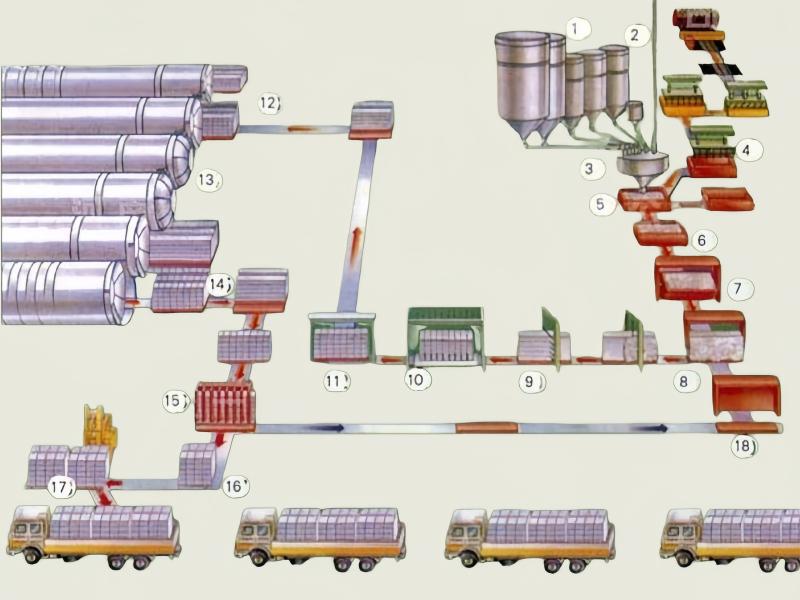
Capabilities of AAC Block Herstellungsmaschinen
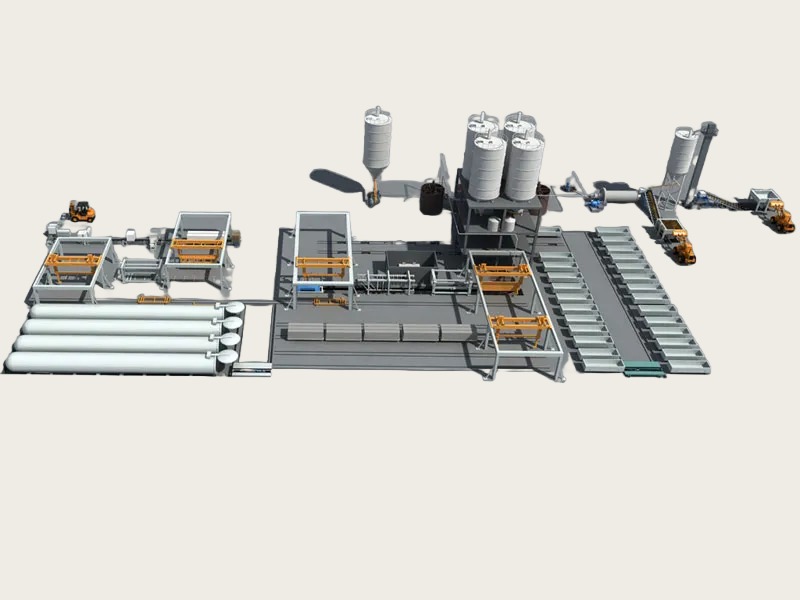
Mini/klein AAC Production Line
Kapazität: 30000-100000 m3/Jahr
Autoklav: 1-3 Sätze
Fabriketwa 4000-10000m2
TypenHalbautomatisch/Vollautomatisch
Eigenschaften: geringe Anfangsinvestitionen, hohe Flexibilität.
Geeignet für: Neugründungen oder Unternehmen mit begrenzten Investitionen und geringer Marktnachfrage.
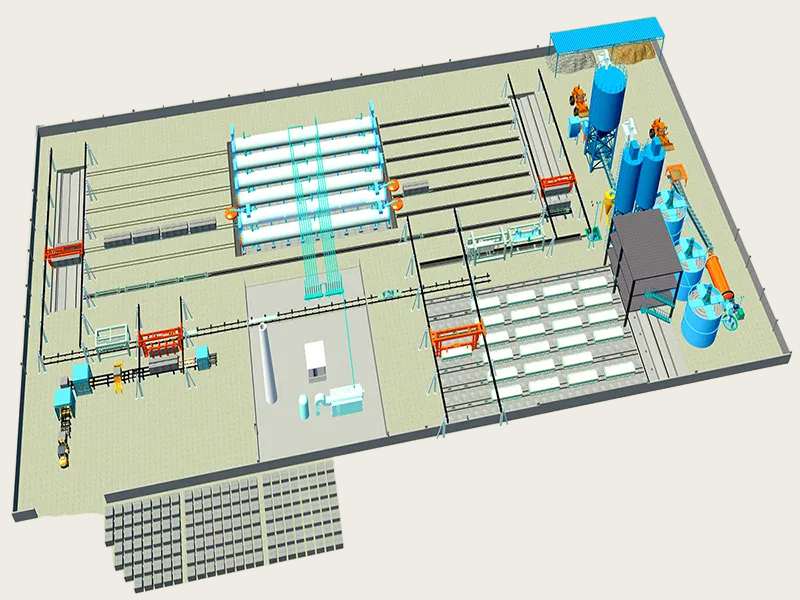
Mittlere Skala AAC Production Line
Kapazität: 100000-200000 m3/Jahr
Autoklav: 4-8 Sätze
Fabriketwa 10000-20000m2
TypVollautomatisch
EigenschaftenStabiles Produktionsvolumen, kontrollierbare Kosten, Flexibilität und Großproduktion.
Geeignet für: Unternehmen mit einem gewissen Marktanteil und stabiler Nachfrage.
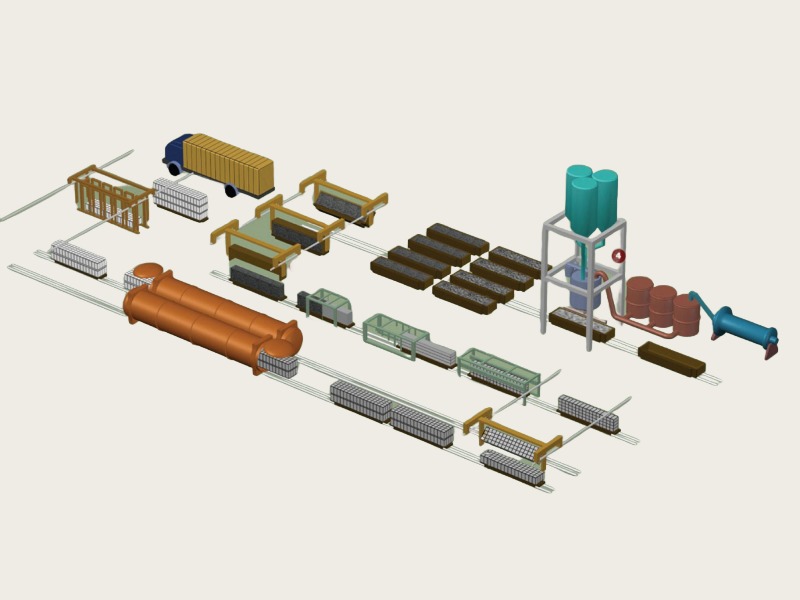
Full Equipment List in AAC Production
1. Ausrüstung zur Handhabung von Rohstoffen
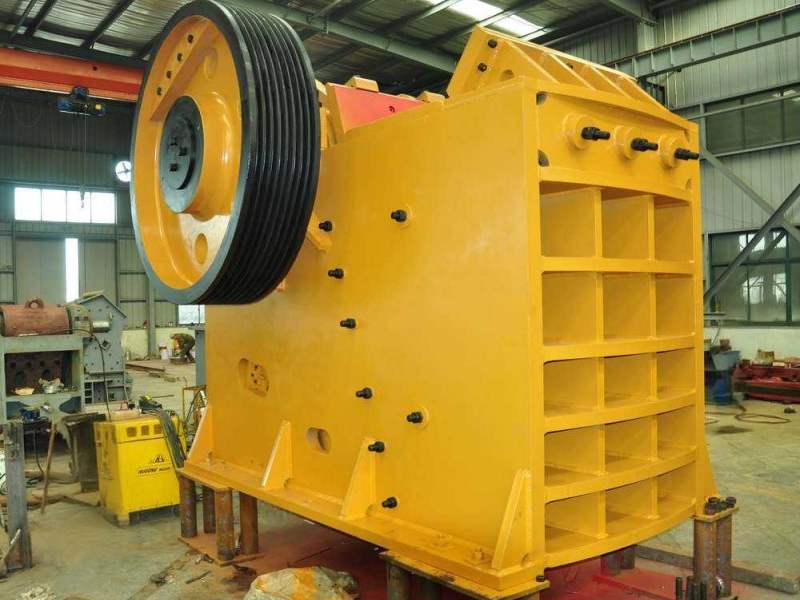
Brecher: Zerkleinert Rohstoffe wie Sand und Kalk auf die gewünschte Korngröße. Backenbrecher werden für harte Materialien und Prallbrecher für die Feinzerkleinerung eingesetzt.
Screener: Das Vibrationssieb entfernt Verunreinigungen und stellt sicher, dass die Partikel des Rohmaterials eine einheitliche Größe haben.
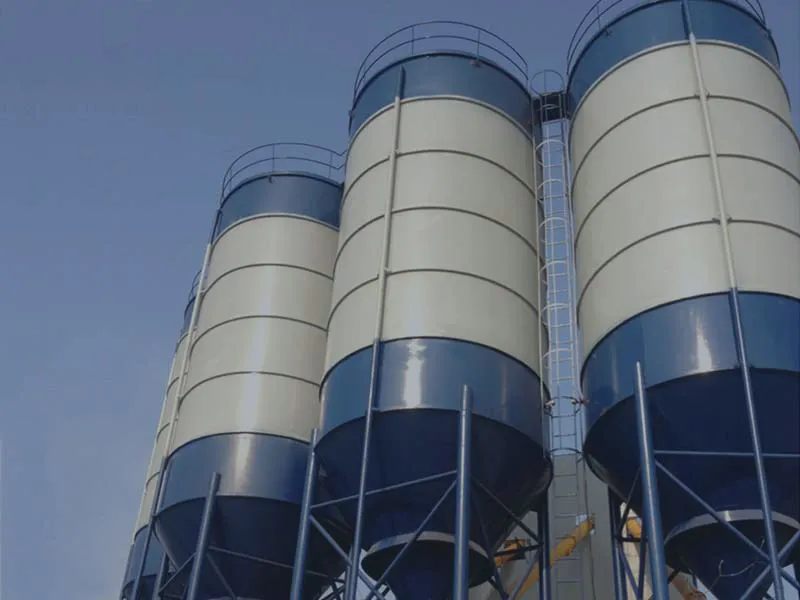
Lager-Silo: Lagert vorbehandelte Rohmaterialien. Er verfügt über einen Füllstandsmesser und eine Staubabsaugung, um die Produktion kontinuierlich aufrechtzuerhalten und die Anforderungen des Umweltschutzes zu erfüllen.
Waage: Band- oder Spiralwaagen messen die Rohmaterialmengen genau, um Rezepturfehler zu minimieren.
2. Misch- und Verschäumungsanlagen
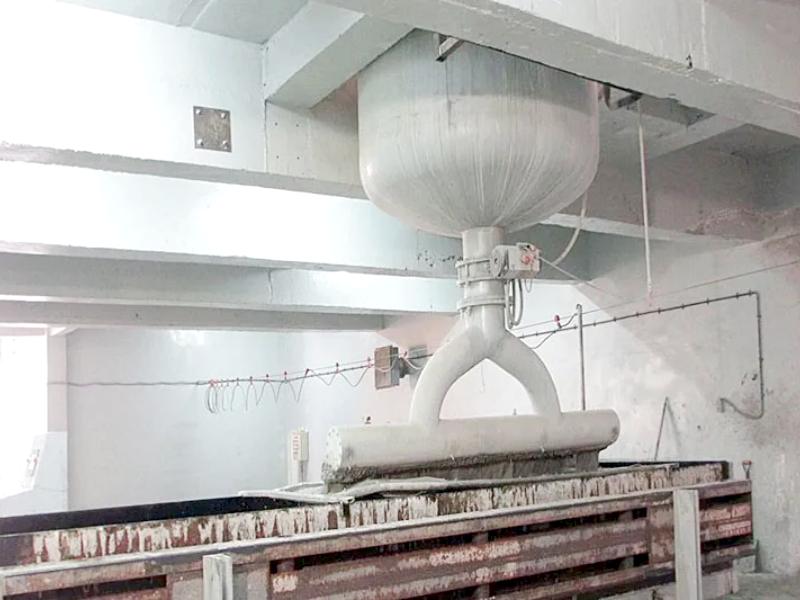

Zwangsmischer: Mischt feste Rohstoffe und Wasser mit hoher Geschwindigkeit zu einem gleichmäßigen Schlamm, der die Grundlage für die Schaumbildung bildet.
Aluminium-Pulver-Mischbehälter: Mischt Aluminiumpulversuspension bei niedriger Geschwindigkeit, um Sedimentation zu verhindern und eine gleichmäßige Dispersion zu gewährleisten.
Schäumendes System: Die Aluminiumpulversuspension wird in einem bestimmten Verhältnis eingespritzt, um mit dem Schlamm zu reagieren und Blasen zu erzeugen, die dann mit dem Mischer zur automatischen Steuerung verbunden werden.
3. Guss- und Formgebungsausrüstung
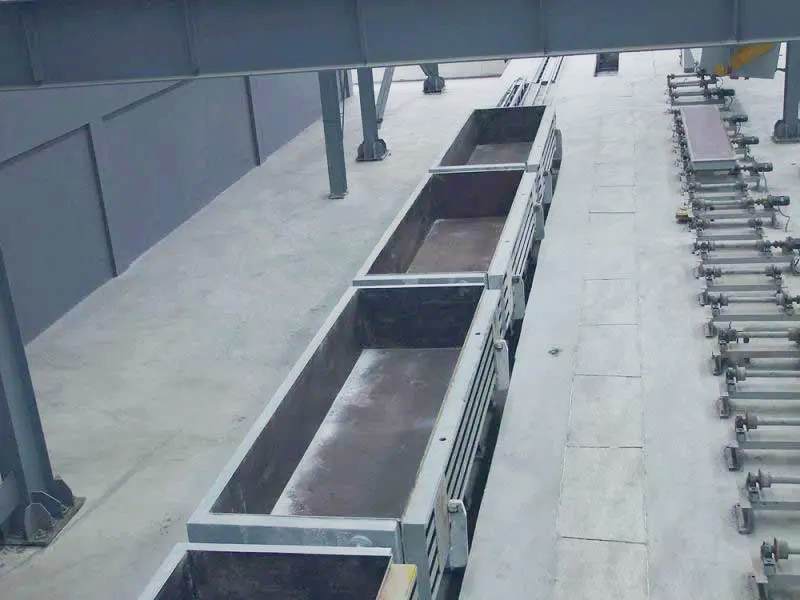
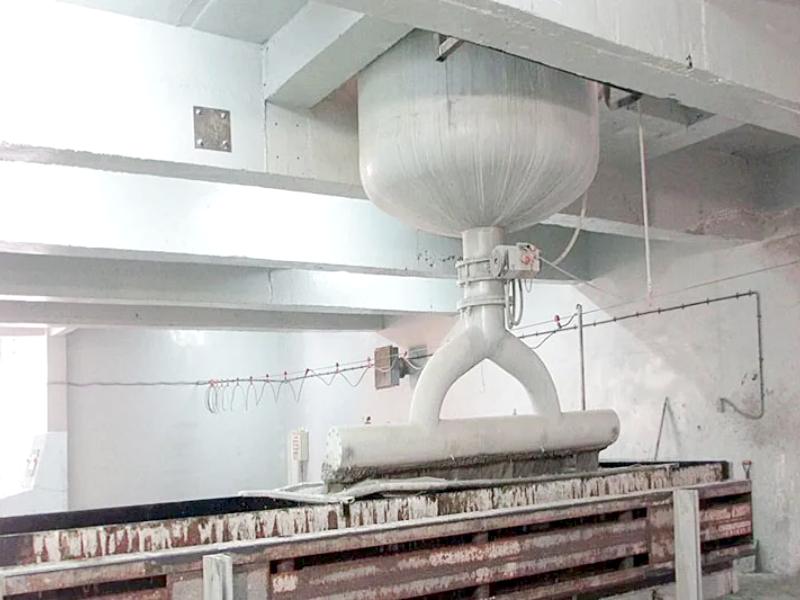
Schimmelpilze: Maßgefertigt aus hochfestem Stahl mit spezieller Oberflächenbehandlung, in der Größe anpassbar an die verschiedenen Produktspezifikationen.
Gießereimaschinen: Die Einspritzmenge der Gülle wird präzise gesteuert, und einige sind mit einer automatischen Bewegung ausgestattet, um Materialmangel oder Überlauf zu vermeiden.
Härtekammer: Eine konstante Temperatur- und Feuchtigkeitsumgebung sorgt für die Belüftung des Schlamms und seine anfängliche Aushärtung, was zu einer gleichmäßigen porösen Struktur führt.
4. Schneidausrüstung
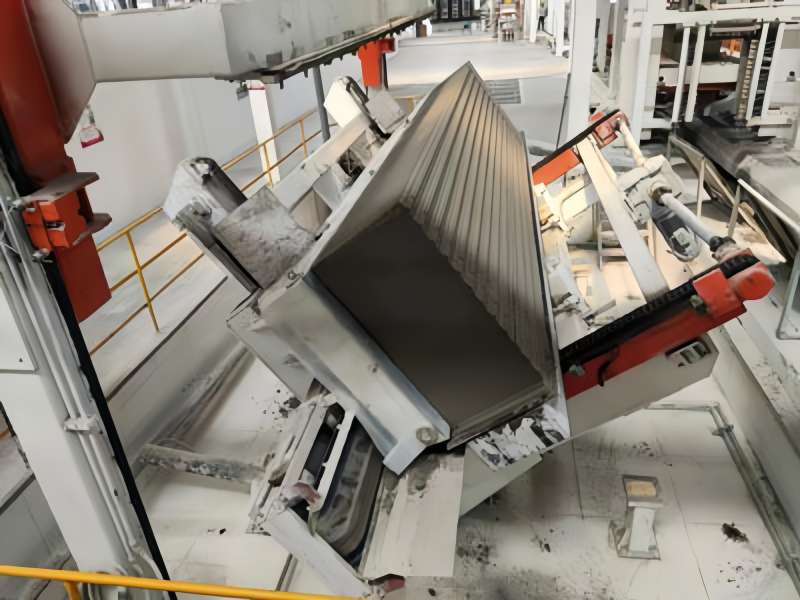
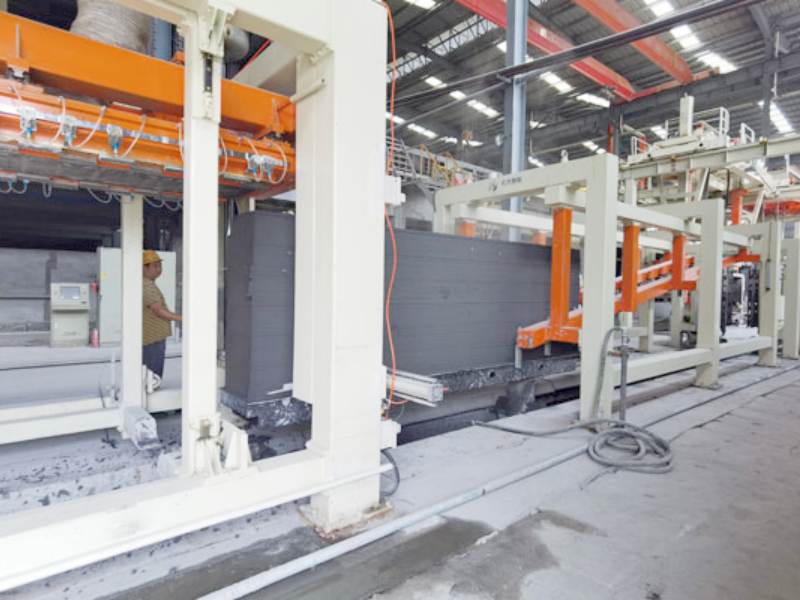
Drehtisch: Der hydraulische Antrieb sorgt für eine gleichmäßige Drehung der Formen und Rohlinge, was das Entformen und Schneiden erleichtert.
Drahtsäge: Verwendet mehrere Sätze hochfester Stahldrähte für Hochgeschwindigkeitsschnitte. Ein CNC-System sorgt für millimetergenaues Schneiden. Bei großen Drahtsägeanlagen ist ein kontinuierlicher Schnitt an mehreren Stationen möglich.
5. Autoklaven-Härtungsgeräte
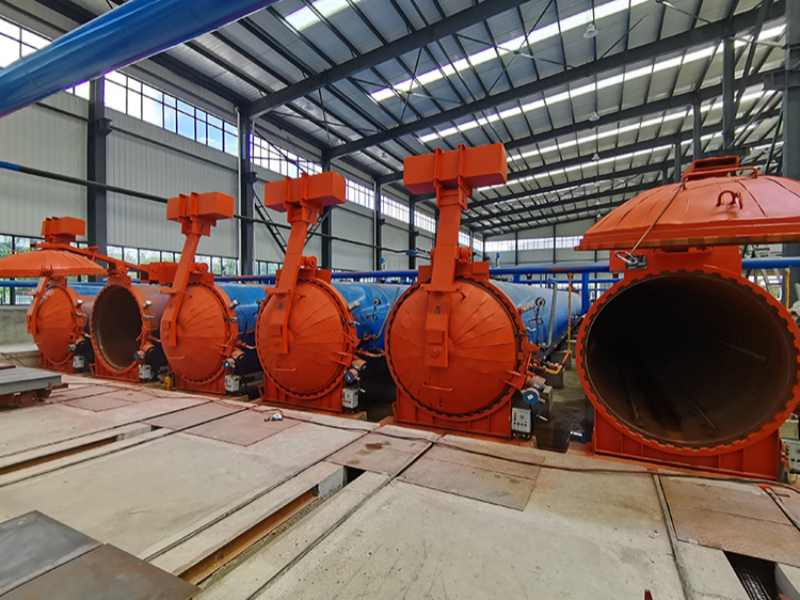

Autoklaven: Große Druckbehälter härten Rohlinge bei Temperaturen von 180-200°C und Drücken von 10-12 bar aus und bilden hochfeste Kalziumsilikathydrate. Ausgestattet mit Sicherheitsverriegelungen.
6. Hilfsmittel

Dampfkessel: Lieferung von stabilem Dampf für Autoklaven und Aushärtekammern, mit verschiedenen Beheizungsoptionen verfügbar.
Luftkompressor: Liefert Druckluft für pneumatische Geräte und stellt sicher, dass Ventile, Klemmen und andere Geräte ordnungsgemäß funktionieren.
Förderbandsystem: Transportiert Materialien durch den gesamten Prozess. Verwendet Band- oder Kettenförderer (je nach Materialbedarf) für eine automatisierte, kontinuierliche Bewegung.
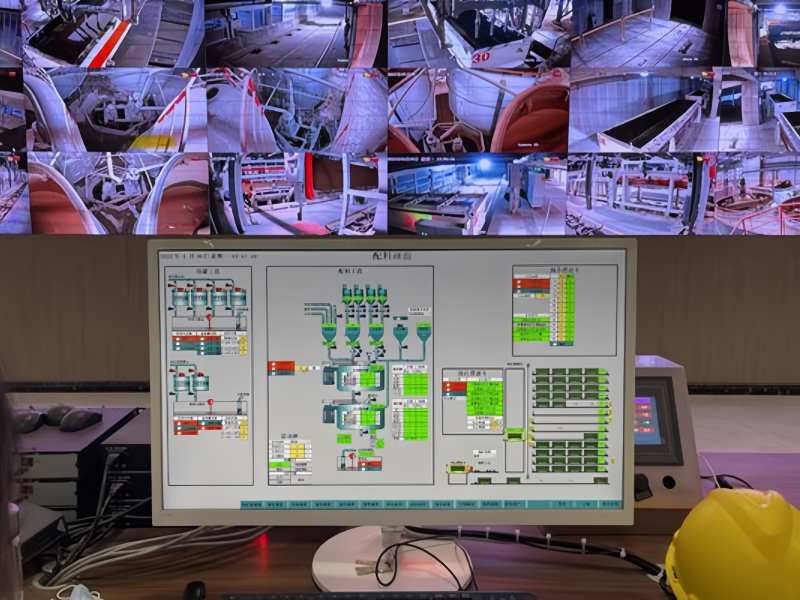
Kontrollsystem: PLC- oder DCS-Systeme überwachen und regulieren Produktionsparameter in Echtzeit. Sie zeichnen Daten für die Verwaltung und Rückverfolgbarkeit auf und helfen, Probleme umgehend zu beheben.
Key Machinery Explained (Cutting / Autoclave)
If we simplify AAC production into two “critical control points”, it is always:
1. Cutting System — determines dimensional accuracy
Cutting is where most quality problems appear.
| Artikel | Impact |
|---|---|
| Cutting accuracy | Block size consistency |
| Wire tension stability | Surface smoothness |
| Cutting speed | Plant capacity limit |
Even a small deviation in cutting precision will lead to:
- Increased mortar usage on site
- Higher rejection rate
- Customer complaints in construction use
That is why we usually spend more design time here than anywhere else.
2. Autoclave System — determines strength and stability
Autoclaving is not just “curing with steam”.
It defines:
- Final compressive strength
- Shrinkage behavior
- Long-term stability
If steam distribution is uneven, the plant will never achieve consistent product quality, even if everything upstream is correct.
Machinery Configuration for Different Plant Sizes
We do not recommend one fixed configuration for all projects. Capacity changes everything.
| Kapazität | Configuration Level | Typical Market |
|---|---|---|
| 100.000 m³/Jahr | Basic semi-auto system | Emerging markets |
| 150,000 m³/year | Standard full line | Growing demand |
| 200,000 m³/year | High stability automation | Stable markets |
| 300.000 m³/Jahr | Fully integrated EPC system | Large-scale infrastructure |
One mistake we often see: clients buying “over-configured” equipment for small markets. That usually leads to idle capacity and cash flow pressure.
Machinery Cost & ROI Considerations
Cost is not just about equipment price. In AAC projects, we always look at output stability vs investment ratio.
Example comparison:
| Artikel | Low Configuration | Optimized Configuration |
|---|---|---|
| Investment | Lower upfront | Higher upfront |
| Labor dependency | High | Low |
| Defect rate | Higher | Lower |
| Amortisationsdauer | Unstable | Predictable (2–3 years typical) |
A cheaper plant is not always cheaper in operation.
In many cases, the real cost appears after commissioning—not during purchase.
How to Evaluate an AAC Machinery Supplier
When clients compare suppliers, we usually tell them not to focus on price first.
Instead, evaluate these three points:
- Whether the supplier understands full process integration
- Whether similar plants have been successfully commissioned
- Whether layout and capacity are designed, not just quoted
If a supplier only sends a machine list without process design, that usually leads to integration issues later.
Real Client Decision Cases
The following two projects are quite different in scale, but they show how capacity, market positioning, and technical choices affect the outcome.

In this project, the client initially compared multiple suppliers based only on price.
The lowest offer excluded several key systems, especially in:
- Material handling automation
- Cutting system stability design
After technical review, the client selected a mid-range configuration instead of the cheapest option.
Result after commissioning:
- Stable production within the first month
- Lower defect rate than expected
- Faster ramp-up to design capacity
The key decision factor was not price—it was system completeness.

The Italy project had a different priority: product consistency. Here, the client was less sensitive to initial cost and more focused on:
- Dimensional precision
- Energy efficiency
- Long-term maintenance stability
We adjusted the configuration accordingly:
- Higher-precision cutting system
- Optimized autoclave heat distribution
- Enhanced control automation system
Result:
- Very stable block quality
- Low maintenance frequency
- Strong acceptance in local construction market
In this case, investing slightly more upfront reduced long-term operational issues significantly.
FAQs
Q1: Is AAC machinery standardized?
No. It is always adjusted based on capacity, raw materials, and layout conditions.
Q2: What is the most important machine in AAC production?
Cutting system and autoclave system have the highest impact on product quality.
Q3: Can I start with partial equipment and expand later?
Yes, but expansion planning must be included in initial layout design.
Q4: How long does installation take?
Typically 6–10 months depending on plant size and local conditions.
Q5: Do you provide installation support?
Yes, commissioning support is essential for stable production start-up.




Get a Customized Equipment List & Quotation
If you are evaluating an AAC project, the worst approach is to ask for a standard price list.
What actually works better is to define your project conditions first:
- Target capacity
- Raw material type (fly ash or sand)
- Market location
- Budget range
Based on this, we can provide:
- Full equipment configuration
- Layout suggestion
- Investment estimate
- ROI reference model
This is closer to how we design real projects, not catalog-based sales.