
What Is a Small AAC Block Plant?
A small AAC (Autoclaved Aerated Concrete) block plant is a compact production line designed to manufacture lightweight blocks using raw materials such as cement, lime, fly ash, aluminum powder, and gypsum. Despite its smaller size, it includes all essential equipment — mixers, cutting machines, autoclaves, and packing systems — ensuring stable output and consistent product quality.
If you are planning to start your own AAC block manufacturing business but want to begin with a smaller investment, understanding the AAC Block Small Plant Cost is the first step. A small AAC plant offers an efficient and affordable way to produce high-quality lightweight concrete blocks while minimizing startup expenses — making it the perfect choice for local markets, regional suppliers, and new entrepreneurs entering the construction materials industry.
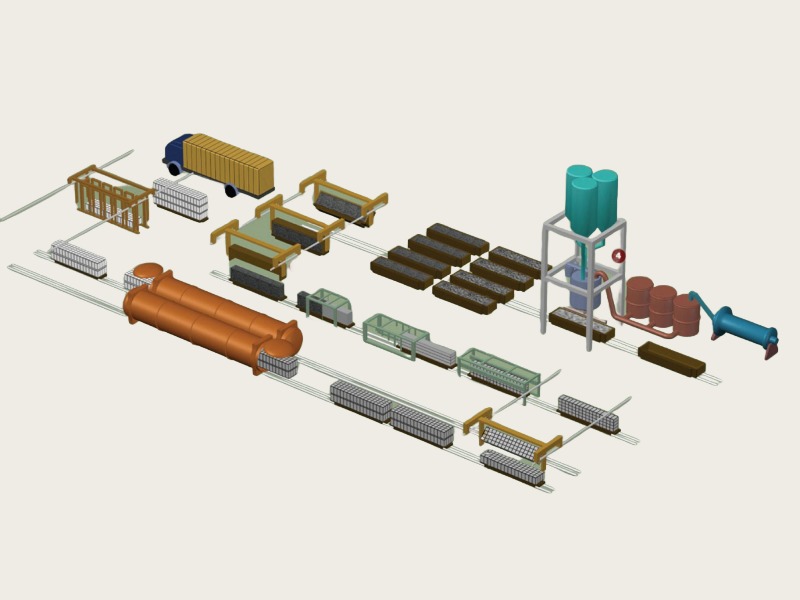
AAC Block Small Plant Cost Overview
Die AAC Block Small Plant cost mainly depends on its production capacity, automation level, and local installation costs.
| Größe der Pflanze | Kapazitätsbereich (CBM/Jahr) | Bereich der Einrichtungskosten | Am besten für |
| Kleine AAC-Anlage | 30,000 - 100,000 | 100.000 bis 1.000.000 USD | Neue Investoren, lokale Märkte |
| Mittlere AAC-Anlage | 100,000 - 200,000 | 1.200.000 bis 2.300.000 USD | Wachsende Nachfrage, regionales Angebot |
For most new investors, we recommend starting with a small AAC plant of around 50,000 m³/year, which can usually be set up with a budget between $300,000 and $700,000 USD, depending on automation level and site conditions.
Factors Influencing AAC Block Small Plant Cost
Several elements can affect the total investment:
- Automation level (manual vs. full automatic)
- Production capacity and daily output
- Local cost of raw materials
- Land and infrastructure requirements
- Energy efficiency and machine durability
- After-sales service & spare parts availability
A professional manufacturer can design an optimized solution that fits your site layout, budget, and target output — helping you reduce unnecessary costs.
AAC Small Plant Production Process Flow
A kleine AAC-Blockanlage follows a complete and precise production process to ensure each block meets quality standards for strength, density, and insulation.
Below is the simplified AAC block manufacturing process flow — from raw material preparation to final packaging:
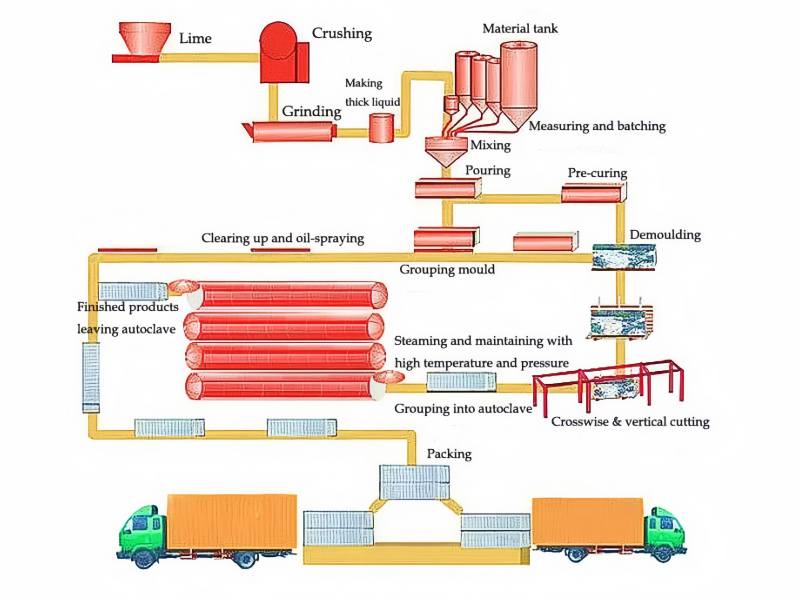
1️⃣ Raw Material Preparation & Batching
Cement, lime, fly ash (or sand), gypsum, and aluminum powder are weighed and mixed in exact proportions according to the formula.
2️⃣ Slurry Mixing & Pouring
The mixed slurry is poured into molds. During this stage, chemical reactions between lime and aluminum powder release hydrogen gas, creating a porous structure.
3️⃣ Pre-curing
The green cake expands and gains initial strength in a pre-curing chamber (40–50 ℃) for 2–3 hours.
4️⃣ Demolding & Cutting
The semi-solid cake is removed from the mold and sent to a cutting machine for horizontal and vertical precision cutting, forming uniform blocks.
5️⃣ Autoclaving (High-Pressure Steam Curing)
Cut blocks are placed into autoclaves and cured under high temperature and pressure (180–200 ℃, 12–16 bar) for 10–12 hours. This process gives AAC blocks their final strength and stability.
6️⃣ Packing & Storage
After curing, blocks are inspected, stacked, and packed for transportation or sale.
What’s Included in a Small AAC Block Plant?
Even a small plant includes all the essential equipment required for continuous production:
- Raw material batching & mixing system
- Mold casting and pre-curing section
- Cutting machine (horizontal & vertical cutting)
- Autoclave system for steam curing
- Block handling and packaging system
Our company provides a turnkey solution — from layout design and equipment manufacturing to installation, training, and after-sales support — helping you start production quickly and safely.
Recommended Equipment List for Small AAC Block Plant
Below is a recommended equipment configuration for a 30,000–100,000 m³/year small AAC plant, designed to balance cost efficiency and production quality.
| Section | Hauptausrüstung | Function / Description |
|---|---|---|
| Vorbereitung des Rohmaterials | Ball mill / fly ash silo / lime silo / slurry tank | Grinding and storage of raw materials |
| Batching & Mixing System | Automatic weighing & mixing system | Ensures accurate proportion of raw materials |
| Casting Section | Moulds and casting crane | Pouring slurry into molds for block formation |
| Pre-curing System | Pre-curing chamber with heating system | Allows block expansion and initial strength |
| Cutting Section | Vertical & horizontal cutting machine | High-precision cutting for uniform block size |
| Autoklaviersystem | Autoclaves (steam curing tanks) | Strengthening and solidifying AAC blocks |
| Handling & Packing | De-moulding crane, stacking machine, packing system | Automated handling and final packaging |
| Electrical & Control System | PLC control cabinet | Centralized control and operation monitoring |
💡 Tip: For small plants, semi-automatic systems are most cost-effective — they reduce labor costs without the high investment of full automation.
50,000 m³/year AAC Small Plant in Kenya

In 2024, our company helped a construction materials firm in Kenya set up a 50,000 m³/year AAC small plant.
Within four months, the factory started stable production.
The client reported:
- 25% reduction in labor cost thanks to automation,
- Rapid local market growth due to rising demand for lightweight blocks,
- ROI (Return on Investment) achieved in under two years.
Why Choose Us as Your AAC Block Manufacturing Plant Manufacturer
We are a leading AAC block manufacturing plant manufacturer, providing turnkey AAC block production lines to clients around the world.
Our Advantages:
✅ Factory-direct machinery cost — no middlemen
✅ Customized layout and capacity planning
✅ Full installation & training services
✅ Long-term technical support
✅ Proven success in over 20 countries
Whether you’re starting a new project or upgrading your existing facility, we provide reliable AAC blocks machinery at competitive prices.
📞 Ready to Start Your AAC Block Small Plant?
Whether you want a 30,000 m³/year mini plant or a 100,000 m³/year small plant, our engineering team provides:
- Free project consultation & cost estimation
- Customized plant layout design
- On-site installation and training
📩 Kontakt today to get your AAC Block Small Plant Cost quotation and start your lightweight block business confidently with a reliable partner.




FAQ
Herstellung (in unserer 120.000 m² großen Fabrik): 45-90 Tage (abhängig von der Kapazität)
Versand: 20-40 Tage (variiert je nach Zielhafen)
Vor-Ort-Installation und Inbetriebnahme.
- 30.000-100.000 m³: 90 Tage
- 200,000-300,000 m³: 120 Tage
- 600,000 m³: 150 Tage
Der Zeitplan beginnt, wenn wir die Anzahlung erhalten - wir stellen ein detailliertes Gantt-Diagramm zur Verfügung, um den Fortschritt zu verfolgen.
Unbedingt. Als professioneller Hersteller von Porenbetonanlagen bieten wir eine umfassende Schulung an.
- 2 Wochen Werksschulung in China (Ihr Team lernt die Bedienung der Geräte)
- 45 Tage Vor-Ort-Schulung (unsere Ingenieure unterrichten Formelanpassung, Qualitätskontrolle und Wartung)
- Handbücher in englischer Sprache (Formeln für die Klassen B04/B05/B06, Labortestverfahren, Anleitungen zur Fehlersuche)
- Lebenslanger Remote-Support (über Teams/Zoom - unsere Techniker reagieren bei dringenden Problemen innerhalb von 4 Stunden)
Ja. Unsere Ausrüstung hält CE, ISO 14001 (Umweltmanagement), ISO 9001 (Qualitätsmanagement), GOST (für GUS-Länder) und SONCAP (für Nigeria) Zertifizierungen. Wir bieten auch Brenner mit niedrigem NOx-Gehalt (<30 mg/Nm³) und Staubabscheidungssysteme an, um die strengen weltweiten Vorschriften zu erfüllen.
Wir arbeiten mit Sinosure (Chinas Exportkreditagentur) und der Standard Chartered Bank zusammen, um Leasingverträge für Geräte mit einer Laufzeit von 3 bis 5 Jahren anzubieten. Die Kunden benötigen nur 15% Startkapital - perfekt, um den Investitionsdruck im Vorfeld zu verringern.
Unsere wichtigsten Geräte (Autoklaven, Mischer, Schneidemaschinen) haben eine Lebensdauer von 15-20 Jahre - dank hochwertigem Stahl (Q345R für Autoklaven) und präziser Fertigung. Wir bieten außerdem eine 5-Jahres-Garantie auf die wichtigsten Komponenten.