
Why Do Buyers Look for a 32 m3/day AAC Block Manufacturing Plant?
Most buyers searching for a 32 m³/day AAC block manufacturing plant fall into one of the following categories:
- Investors exploring AAC technology for the first time
- Developers planning to supply AAC blocks for their own construction projects
- Small local producers serving isolated or low-demand areas
- Technical institutes or training centers requiring demonstration lines
- Buyers with very limited initial investment budgets
This capacity is usually not driven by large market demand, but by a desire to start small, test the process, or minimize upfront risk.

What Is the Actual Annual Output of a 32 m³/day AAC Plant?
Understanding real production capacity is critical before making any investment decision.
Under standard industry assumptions:
- Daily output: 32 m³
- Working days per year: 280–300 days
This results in an annual output of approximately 8,500–10,000 m³ of AAC blocks.
This figure reflects realistic operating conditions, including maintenance and downtime. Any claim significantly above this range should be carefully verified.
Who Is a 32 m³/day AAC Block Plant Really Suitable For?
A 32 m³/day AAC block manufacturing plant is best suited for:
- Pilot or trial AAC production
- Self-use AAC block supply for small construction projects
- Remote regions with very limited market demand
- Research, testing, or operator training purposes
However, it is not recommended for:
- Commercial AAC block sales in competitive markets
- City-level or regional material supply
- Investors seeking fast ROI through volume production
Setting the right expectations at this stage avoids costly mistakes later.
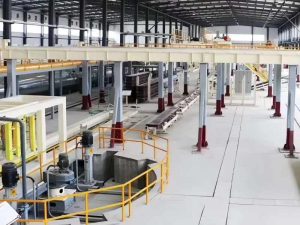
Production Line Configuration of a 32 m³/day AAC Block Plant
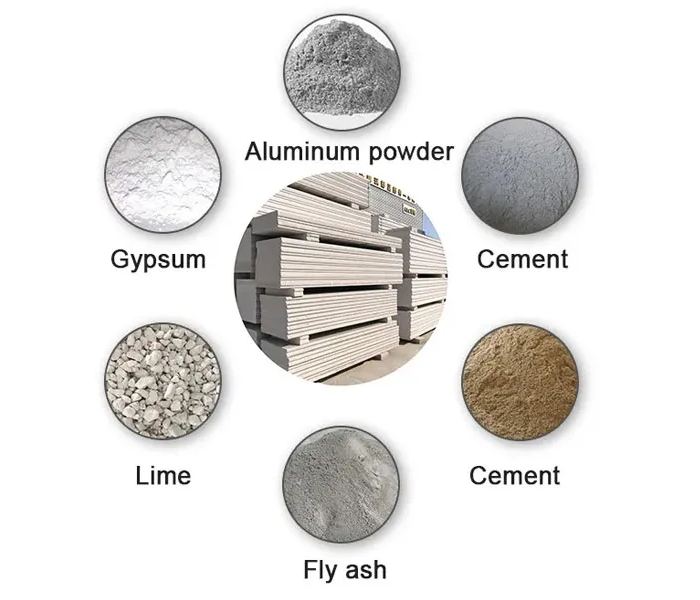
Despite its small capacity, a true AAC plant must still follow the complete AAC production process.
Preparação de matérias-primas
- Cement, lime, and gypsum feeding systems
- Simplified sand or fly ash preparation
- Basic batching accuracy suitable for small volumes
Mixing and Casting
- Slurry mixing unit with manual or semi-automatic operation
- Aluminum powder dosing adapted to small batch sizes
- Compact mold system
Pre-Curing and Cutting
- Basic pre-curing setup
- Simplified cutting frame
- Manual assistance during handling
Autoclavagem
- Small-sized autoclave
- Steam supplied by boiler or external source
- Limited curing batch size
While technically complete, this configuration prioritizes simplicity over efficiency.
Technical Limitations You Should Understand Before Investing
From a manufacturing and engineering perspective, small AAC plants come with inherent limitations:
- Higher cost per cubic meter due to lack of scale
- Labor-intensive operation
- Limited automation options
- Greater difficulty maintaining consistent quality
- Minimal buffer for production errors
These factors directly affect long-term operating stability and profitability.
Investment Cost vs. Operating Reality
A 32 m³/day AAC block plant does require a lower initial equipment investment, but this does not automatically mean lower overall cost.
Key realities include:
- Fixed costs spread over limited output
- Higher labor cost per unit
- Lower tolerance for raw material price fluctuation
- Limited ability to reduce production cost
For this reason, ROI expectations should be conservative and realistic.
Land Requirement and Infrastructure Needs
Even at small capacity, AAC production requires proper infrastructure:
- Estimated land area: 8,000–12,000 m²
- Reliable electricity and water supply
- Steam source for autoclaving
- Manual material handling and storage areas
Infrastructure quality directly impacts product consistency and safety.
When Should You Upgrade from 32 m³/day to a Larger AAC Plant?
In practice, many buyers outgrow this capacity faster than expected.
Common signals that an upgrade is necessary include:
- Demand exceeding daily production capacity
- Rising labor costs affecting unit price
- Difficulty competing with larger AAC suppliers
- Increasing quality consistency requirements
Typical upgrade paths move toward 50, 100, or 150 m³/day AAC block manufacturing plants, where efficiency and cost control improve significantly.
Turnkey Support and Customization Options
For small-capacity AAC projects, professional support is even more important.
A responsible AAC plant supplier should offer:
- Honest capacity evaluation before quotation
- Customized configurations based on project purpose
- Installation guidance and operator training
- Technical support during trial production
This approach minimizes operational risk and protects your investment.
Outros Fábrica de blocos de venda a quente
| Produção anual | Preço (USD) | Configuração do núcleo |
|---|---|---|
| 100,000 m³ | 1.5-1.9 M | Corte por rotação de ar, autoclaves de 3×31 m |
| 150,000 m³ | 2.1-2.6 M | Paletização robotizada, autoclaves de 4×31 m |
| 200,000 m³ | 2.8-3.5 M | Corte de seis lados, autoclaves de 4×37 m |
| 300,000 m³ | 4.0-4.8 M | Linhas de corte duplas, autoclaves de 6×37 m |
| 400,000 m³ | 5.5-6.5 M | Autoclaves de 8×37 m e superiores, com rotação de ar totalmente automática |
Make the Right Capacity Decision Before You Invest
A 32 m³/day Fábrica de blocos AAC can be a valid solution for trial production, self-use projects, or limited-demand applications. It is not designed for mass production or aggressive market competition.
If your goal is long-term commercial success, choosing the right capacity from the beginning is far more important than choosing the lowest initial price.
Contactar-nos today to discuss your project objectives, market conditions, and budget. Our technical team will help you determine whether a 32 m³/day AAC plant is suitable—or whether a higher-capacity solution will better support your business growth.
Visão geral das capacidades de venda a quente



Fábrica de CCA relacionada



Relacionadas: Custo da fábrica de blocos AAC, Fabricante de instalações de CCA, Máquina de fazer blocos AAC