
A Practical Production Scale for Long-Term Market Growth
With the global construction industry increasingly focused on lightweight structures, energy efficiency, and faster building cycles, Autoclaved Aerated Concrete (AAC) blocks have become a mainstream building material in many developing and emerging markets.
For manufacturers and investors evaluating entry or expansion in the AAC sector, a 70,000–100,000 m³ per year AAC block manufacturing plant is widely recognized as a commercially reliable and technically mature production scale—large enough to reduce unit costs, yet flexible enough to match real market absorption.
This page explains how this capacity range works in practice, what equipment configuration it involves, and why it has become a preferred choice for sustainable AAC block businesses.

What Does a 70,000–100,000 m³/Year AAC Block Plant Mean in Real Production?
A 70,000 to 100,000 cubic meters per year AAC block manufacturing plant is designed for continuous, industrial-scale production with stable output and controlled operating costs.
Under normal operating conditions, this capacity typically corresponds to:
- Approximately 230–330 m³ of AAC blocks per day
- One or two production shifts, depending on labor strategy
- Annual output sufficient to supply one major city or multiple regional markets
This scale avoids the instability of small plants while eliminating the sales pressure often associated with oversized production lines.
Who Is This AAC Block Plant Capacity Designed For?
This capacity range is especially suitable for:
- Medium-scale AAC block manufacturers planning steady expansion
- Investors upgrading from 20,000–50,000 m³/year AAC plants
- Building material suppliers serving urban and regional distributors
- Developers supplying AAC blocks for residential and commercial projects
- Markets where AAC adoption is accelerating but competition remains manageable
In many regions, 70,000–100,000 m³ per year represents a well-balanced commercial capacity, aligned with actual construction demand and realistic distribution capabilities.
Core Systems of a 70,000–100,000 m³ AAC Block Manufacturing Line
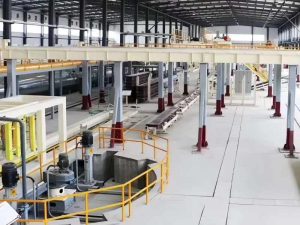
A standard AAC block manufacturing plant in this range consists of fully integrated systems designed for efficiency and consistency.
Preparação de matérias-primas
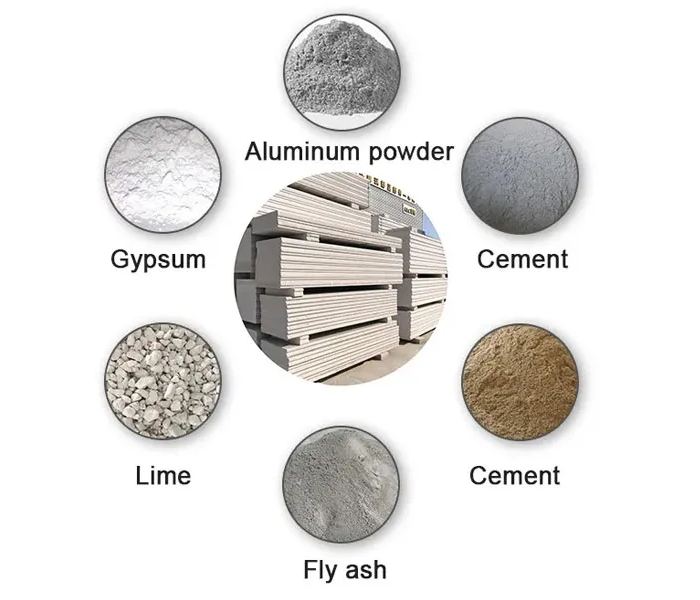
- Cement, lime, gypsum, and silica sand or fly ash handling
- Ball mill or sand grinding unit
- Precise batching and weighing system
Mixing and Casting
- High-performance slurry mixing equipment
- Controlled aluminum powder dosing
- Casting molds suitable for standard AAC block dimensions
Pre-Curing and Cutting
- Controlled pre-curing chambers
- Horizontal and vertical cutting machines
- Accurate cutting tolerance for uniform block size
Autoclavagem
- High-pressure autoclaves with stable steam distribution
- Optimized curing cycles to ensure strength and density consistency
Finished Product Handling
- Block separation and stacking systems
- Optional palletizing and packaging
- Efficient preparation for storage or delivery
Each production line can be configured based on local raw materials, energy availability, labor cost, and automation preference.
Technical Advantages of This Production Capacity
From an engineering and operational perspective, this capacity range offers clear advantages:
- Stable continuous production with predictable daily output
- Improved energy efficiency per cubic meter compared to small plants
- Consistent product quality meeting international AAC standards
- Easier integration of semi-automatic or fully automatic controls
- Lower maintenance pressure and better equipment lifespan
These advantages make the plant suitable for long-term industrial operation, not short-term trial investment.
Investment Scale and Operating Cost Structure
A 70,000–100,000 m³/year AAC block manufacturing plant typically requires:
- Moderate civil construction investment
- Standard industrial power and steam systems
- A manageable workforce size
- Balanced capital exposure compared with large-scale plants
Operating costs are optimized through:
- Efficient raw material utilization
- Reduced energy consumption per unit
- Stable production scheduling
- Predictable maintenance cycles
As a result, many investors achieve faster break-even and more stable cash flow than with oversized production lines.
Plant Layout, Land Requirement, and Infrastructure
A typical plant layout requires:
- Land area: approximately 25,000–35,000 square meters
- Clear separation of raw material storage, production, curing, and finished goods
- Convenient road access for inbound materials and outbound products
- Reliable water, power, and steam supply
A rational layout not only improves current efficiency but also leaves room for future capacity expansion.
Product Range and Market Compatibility
This AAC block plant can produce:
- Standard wall AAC blocks
- Load-bearing AAC blocks
- Customized sizes according to local building codes
Common density classes range from B05 to B07, suitable for most residential, commercial, and public construction projects.
Such flexibility allows manufacturers to adjust product structure as market demand evolves.
Why Many Investors Choose This Capacity Range?
Compared with smaller AAC plants, this scale provides:
- Lower production cost per cubic meter
- More consistent quality control
- Stronger credibility with contractors and developers
Compared with larger plants, it offers:
- Lower initial investment
- Reduced inventory and sales pressure
- Faster market penetration
For many markets, it represents a risk-controlled, commercially proven production scale.
Turnkey Support and Technical Services
A professional AAC plant supplier should offer:
- Project consultation and capacity planning
- Plant layout and process design
- Equipment manufacturing and inspection
- Installation guidance and commissioning
- Operator training and after-sales support
Turnkey solutions significantly reduce implementation risk and shorten the time to full production.
Outros Fábrica de blocos de venda a quente
| Produção anual | Preço (USD) | Configuração do núcleo |
|---|---|---|
| 100,000 m³ | 1.5-1.9 M | Corte por rotação de ar, autoclaves de 3×31 m |
| 150,000 m³ | 2.1-2.6 M | Paletização robotizada, autoclaves de 4×31 m |
| 200,000 m³ | 2.8-3.5 M | Corte de seis lados, autoclaves de 4×37 m |
| 300,000 m³ | 4.0-4.8 M | Linhas de corte duplas, autoclaves de 6×37 m |
| 400,000 m³ | 5.5-6.5 M | Autoclaves de 8×37 m e superiores, com rotação de ar totalmente automática |
Start Building a Profitable AAC Block Business on the Right Scale
If you are planning to invest in an AAC block manufacturing plant or upgrade an existing production line, choosing the right capacity is critical to long-term success.
A 70,000–100,000 m³ per year AAC block manufacturing plant provides a proven balance between investment, output, and market demand—helping you enter the AAC market with confidence and operate sustainably.
Contact us today to receive a customized plant configuration, investment estimate, and production plan tailored to your local market conditions. We are ready to support you from project planning to stable production.
Visão geral das capacidades de venda a quente



Fábrica de CCA relacionada



Relacionadas: Custo da fábrica de blocos AAC, Fabricante de instalações de CCA, Máquina de fazer blocos AAC