What Does “Cheap” Really Mean in AAC Manufacturing?
In industrial equipment, “cheap” can mean two very different things:
- Low purchase price because of lower standards
- Optimized price through efficient manufacturing and direct supply
The first option often leads to:
- Unstable autoclave performance
- Inconsistent block density
- Frequent downtime
- High maintenance costs
- Safety risks
The second option focuses on:
- Cost-optimized engineering
- Scaled manufacturing
- Factory-direct supply
- Rational profit margins
- Long-term operational stability
Our philosophy is simple: Affordable does not mean compromised. It means optimized.
Medium Flyash AAC Block Plant Capacity Explained
A medium capacity flyash AAC block plant typically produces: 100,000 – 200,000 m³ per year
In daily production terms:
- 100,000 m³/year ≈ 300 m³/day
- 150,000 m³/year ≈ 450 m³/day
- 200,000 m³/year ≈ 600 m³/day
This capacity range is ideal for:
- Growing regional markets
- Small to mid-size city construction supply
- Investors upgrading from small AAC lines
- Government housing programs
- Contractors seeking internal block supply
It provides meaningful production scale without the capital burden of very large industrial lines.

Cheap Medium Flyash AAC Block Plant Price Range
For a 100,000–200,000 m³/year project, the realistic investment range is:
USD 200,000 – 1,000,000
The variation depends on:
- Automation level
- Autoclave configuration
- Boiler system
- Raw material system design
- Electrical standard
- EPC scope
Reference Structure
| Capacidade | Configuração | Estimated Investment |
|---|---|---|
| 100 000 m³/ano | Semi-automático | USD 200,000 – 400,000 |
| 150,000 m³/year | Balanced system | USD 350,000 – 650,000 |
| 200,000 m³/year | Fully automatic EPC | USD 600,000 – 1,000,000 |
This includes core production equipment. Civil construction and local infrastructure depend on site conditions.
If a quotation falls dramatically below this range, it is important to examine specifications carefully.
Why Some AAC Plants Are Extremely Cheap?
It is common to see very low quotations in the market. The difference often lies in hidden details.
1 Autoclave Steel Thickness
The autoclave is a pressure vessel operating at:
- 1.2–1.3 MPa
- 180–200°C
Reducing steel thickness reduces cost — but also reduces safety margin and lifespan.
2 Electrical Components
Low-grade PLC systems and electrical parts may cause:
- Inaccurate batching
- Production instability
- Frequent system failures
3 Cutting Machine Precision
Poor cutting systems result in:
- Dimensional deviation
- Increased waste
- Higher reject rate
4 After-Sales Support
Very low price suppliers often provide:
- No proper commissioning
- No technical training
- Limited spare parts support
A plant that saves $50,000 at purchase can easily lose much more during operation.
Our Definition of a Cheap AAC Block Plant
We define “cheap” as:
- Factory-direct pricing
- Optimized structural design
- Standardized module production
- Efficient supply chain integration
- Transparent cost structure
We do not reduce:
- Pressure vessel standards
- Steel grade
- Control system stability
- Critical safety components
Our goal is to deliver a high value AAC plant, not a low-standard plant.
Complete Equipment Introduction
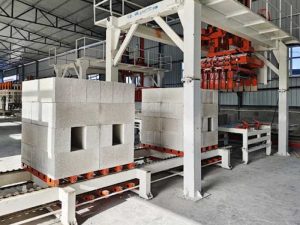
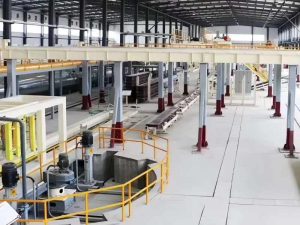
A medium flyash AAC block plant includes the following core sections.
1 Raw Material Preparation Section
Main materials:
- Flyash
- Cal
- Cement
- Gesso
- Pó de alumínio
- Água
Equipment includes:
- Flyash silo
- Transportador de parafuso
- Electronic batching system
- Slurry tank
Accurate weighing ensures stable density and strength.
2 Mixing and Casting Section
- Slurry mixer
- Pouring system
- Mold assembly
- Mold circulation line
Proper mixing directly affects pore structure and compressive strength.
3 Pre-Curing System
Controlled temperature environment ensures:
- Uniform expansion
- Reduced cracking
- Stable internal structure
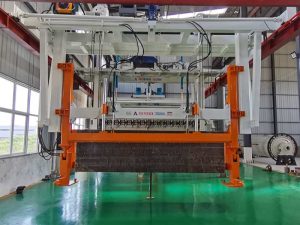
4 Cutting Section
- Tilting crane
- Horizontal cutter
- Vertical cutter
- Waste slurry recycling
High-precision cutting improves:
- Dimensional accuracy
- Market competitiveness
- Reduced material loss
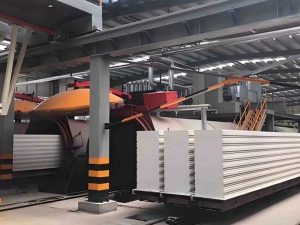
5 Autoclave Section
- Autoclaves
- Steam distribution system
- Pressure monitoring
- Safety valves
This is the heart of the plant and the main investment component.
6 Boiler and Steam System
Options:
- Coal-fired boiler
- Gas-fired boiler
- Biomass boiler
Fuel choice depends on local availability and operating economics.
7 Control System
- Central PLC control
- Touchscreen interface
- Real-time monitoring
Stable automation reduces labor and improves consistency.
Operating Cost Analysis
Investment is only the beginning. Long-term profitability depends on operating cost.
Production Cost Per Cubic Meter
Typical global range:
USD 25 – 45 per m³
Cost structure:
- Raw materials: 45–60%
- Energy: 15–25%
- Labor: 10–20%
- Maintenance: 5–10%
Necessidade de mão de obra
- Semi-automatic: 20–35 workers
- Fully automatic: 12–20 workers
Automation reduces long-term operating expenses.
Energy Consumption
Approximate averages:
- Steam: 220–260 kg/m³
- Electricity: 25–35 kWh/m³
Energy optimization significantly improves margins.

Profit and Return on Investment
In many developing markets:
- Selling price: USD 50–80 per m³
- Gross margin: USD 20–35 per m³
For a 150,000 m³/year plant:
- Annual gross profit potential is substantial
- Payback period typically 3–5 years
Exact ROI depends on:
- Local block pricing
- Flyash availability
- Energy cost
- Market demand stability
Why Choose a Factory-Direct EPC Manufacturer
Working with a direct manufacturer offers advantages:
- Transparent pricing
- No intermediary markup
- Engineering customization
- Integrated production
- Better quality control
- Long-term technical support
As an EPC supplier, we provide:
- Plant layout design
- Equipment manufacturing
- Export packing
- Installation guidance
- Commissioning support
- Operator training
This reduces communication gaps and project risk.
Who Is This Plant Suitable For?
A cheap medium flyash AAC block plant (in the sense of high value) is suitable for:
- First-time AAC investors
- Brick factory owners upgrading production
- Regional construction suppliers
- Government housing material providers
- Emerging market infrastructure projects
It offers:
- Balanced investment
- Manageable risk
- Scalable future expansion
Frequently Asked Questions
How much does a cheap medium AAC block plant cost?
Realistically USD 200,000–1,000,000 depending on configuration.
What is the minimum capacity to start?
100,000 m³/year is a practical entry level for medium scale production.
Can I expand later?
Yes. Many systems are designed with scalability in mind.
Is flyash suitable in all countries?
It depends on chemical composition and supply stability. Analysis is required before final design.
What is included in EPC?
Typically:
- Equipment supply
- Layout design
- Installation guidance
- Commissioning support
- Technical training
The Right Way to Approach a “Cheap” Investment
If your goal is simply the lowest possible purchase price, there will always be someone cheaper.
If your goal is:
- Stable production
- Controlled long-term cost
- Reliable quality
- Sustainable operation
Then the right approach is to choose a supplier who offers:
- Fair pricing
- Transparent specification
- Professional engineering
- Ongoing technical support
Industrial equipment should be evaluated over 10–15 years, not only at the moment of purchase.
Let’s Evaluate Your Project Rationally
If you are planning a 100,000–200,000 m³/year flyash Fábrica de blocos AAC, we can help you:
- Assess your target capacity
- Review local flyash conditions
- Estimate operating cost
- Design plant layout
- Provide a clear and customized quotation
Share your project details with us — including target output, location, and budget expectations — and we will prepare a practical solution tailored to your market.
A reasonable investment, engineered correctly, creates long-term profit.